

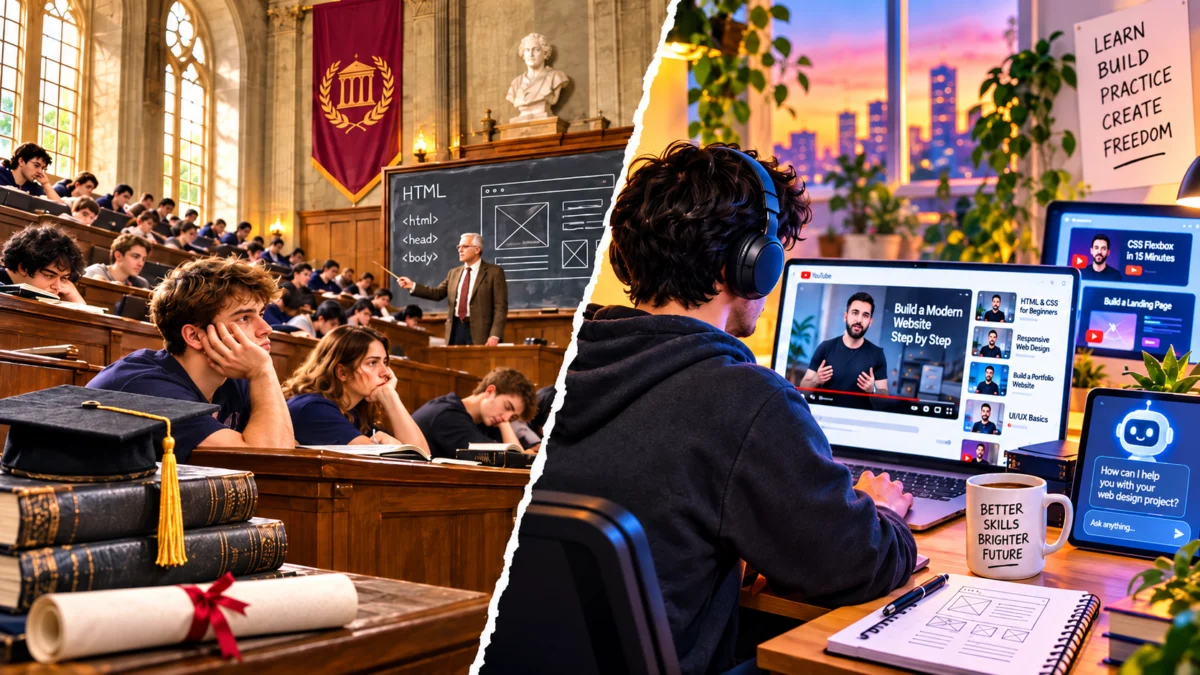
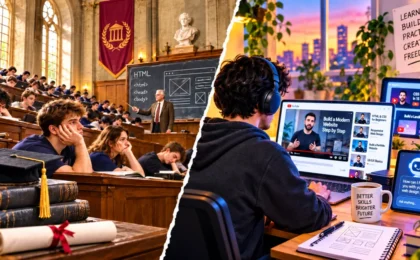
Fifteen years ago, aspiring web designers faced a singular path to breaking into the digital economy: formal education. Entering a classroom or enrolling in a university program was the baseline requirement for anyone hoping to master HTML, CSS, Photoshop, typography, user experience (UX) design, and the complex ecosystem of internet standards. Ingesting this specialized knowledge required institutional gatekeepers—instructors who possessed the keys to understanding how the web operated.
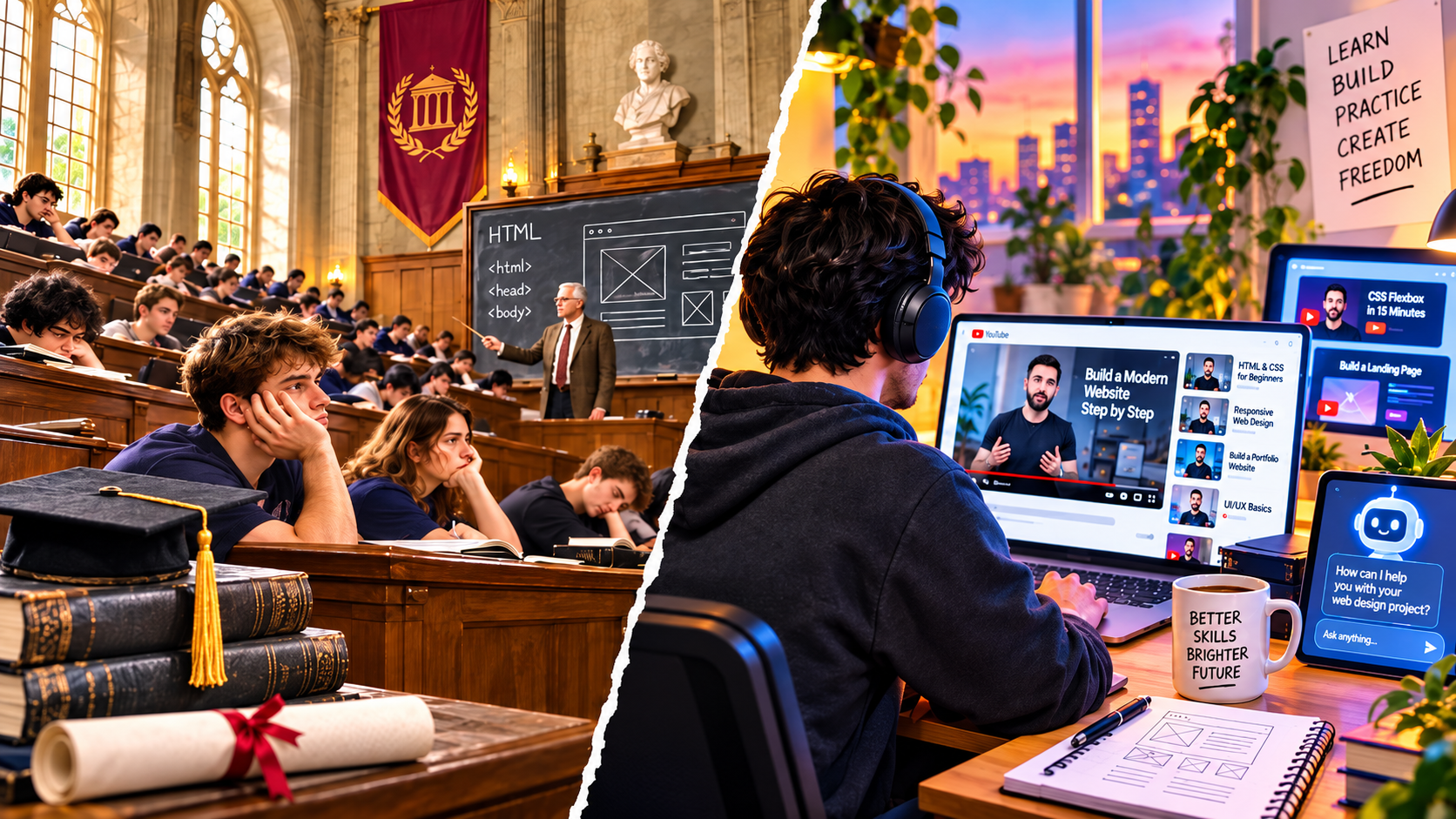
Today, the aspiring designer’s journey looks fundamentally different. The primary classroom is no longer a lecture hall; it is an open browser tab playing a video streaming platform.
Want to master Figma? There are thousands of comprehensive tutorials available at the click of a button. Need to understand CSS Grid? Learners can browse dozens of instructors and pick the teaching style that suits them best. Looking for lessons on web accessibility? Entire courses are streamed for free, unburdened by enrollment caps or prerequisite fees. When a student hits a roadblock or writes code that refuses to render properly, they do not have to wait for office hours. They can immediately ask conversational artificial intelligence models like ChatGPT or Claude to explain the concept, scan the code for syntax errors, identify the root cause of the mistake, and explain how to fix it.
Welcome to the era of YouTube University, where tuition is effectively zero, and traditional institutions of higher education are confronting an existential crisis.
YouTube University Moves a Lot Faster
The friction between traditional academia and the modern digital landscape comes down to velocity. Universities are structurally designed to move slowly, governed by curriculum committees, bureaucratic approval boards, and long-term planning cycles. A traditional university course can take months—sometimes years—to propose, approve, and officially integrate into a degree program.
By contrast, the web moves at breakneck speed. When a new design tool is released, a major framework updates, or a groundbreaking AI capability drops, digital creators often upload detailed tutorials before a student has finished their morning coffee.
Artificial intelligence has widened this already substantial gap. While a YouTube tutorial delivers the lesson, advanced AI tools act as a personalized, on-demand tutor. If a student does not understand a specific snippet of code or a design principle, they can request a simpler explanation, paste in broken files, or ask why a layout breaks across mobile viewports.
Students have already voted with their clicks. The 2026 HEPI Student Generative AI Survey underscores this profound shift, revealing that 95 percent of surveyed UK undergraduates are already integrating AI into their academic lives in some capacity. For modern learners, generative technology is not a futuristic concept to be debated in faculty meetings; it is an everyday companion. Universities are no longer deciding whether students should learn with AI. Students are already doing it, with or without institutional permission.
Then There Is the Uncomfortable Question: Why Pay?
This digital transformation brings an uncomfortable question to the forefront of modern education: why pay tens of thousands of dollars for a degree when the curriculum is available for free?
Consider two parallel paths. One student spends four years and thousands of dollars navigating a traditional degree program. Another student spends those exact same four years watching masterclasses from leading designers and developers on YouTube, leveraging AI tools to accelerate their learning curve, and actually building functional websites. Eventually, both individuals might find themselves applying for the exact same entry-level job.
This dynamic is particularly acute in web design and digital development because the industry relies on tangible proof of skill rather than theoretical examinations. According to data from the U.S. Bureau of Labor Statistics, web developers and digital designers frequently do not need specific educational credentials if they can directly demonstrate their technical and creative abilities through a robust portfolio of real-world projects and practical experience.
In an industry where a compelling portfolio speaks louder than a diploma, prospective students are increasingly forced to ask a blunt question: What exactly are they paying for?
YouTube University Has a Problem Too
Despite its unmatched speed and accessibility, YouTube University is not without its flaws. While the platform can teach almost anything, it is notoriously terrible at guiding learners on what they should learn.
Self-directed learners frequently fall into fragmented rabbit holes. A student might watch a CSS animation tutorial, pivot to an introductory AI design course, spend two hours watching an influencer redesign Spotify, discover a no-code platform like Webflow, and ultimately end up clicking on sensationalized clickbait videos promising immediate mastery.
Nobody forces an independent learner to master web accessibility when they would rather spend their time building flashy, modern animations. Nobody provides structured, rigorous critiques of their portfolio pieces. It is entirely possible to become surprisingly capable through self-teaching while retaining massive, foundational gaps in professional knowledge.
Generative AI shares a similar vulnerability. An AI assistant will happily help a user build a flawed, poorly structured website if the user lacks the foundational understanding required to realize the output is sub-par.
And that precise vulnerability represents the ultimate opportunity for traditional universities.
Stop Competing with YouTube
There is little strategic sense in charging students exorbitant tuition fees to sit in a lecture hall listening to information they could easily absorb from an exceptional instructional video on the internet tonight.
Instead, higher education institutions must pivot toward offering the critical elements that online video platforms and standalone AI tools simply cannot replicate: dedicated mentors, rigorous and honest peer critiques, collaborative group projects, and structured pathways. Universities should challenge students to defend their design decisions, test live websites on real human users, and master the foundational disciplines—such as psychology, typography, color theory, accessibility standards, and UX methodology—that tutorials make tempting to skip.
Furthermore, institutions must embrace AI rather than trying to ban it. Instead of forcing students to spend a week manually coding a rudimentary, boilerplate website from scratch, curricula should leverage AI to generate the initial baseline version immediately. Students can then spend the week critically analyzing what is wrong with the AI-generated code, making it faster, more secure, more accessible, more original, and genuinely useful.
The goal of modern education must be to teach students how to think critically, not merely how to produce code mechanically.
Universities Are Starting to Get It
Some progressive academic institutions are already adapting to this shifting landscape.
The University of Victoria has overhauled its entire computer science curriculum, deliberately integrating artificial intelligence throughout the program rather than relegating it to an optional elective or treating it as an afterthought. Similarly, the University of British Columbia is restructuring its undergraduate offerings to prepare students for an AI-driven future, introducing coursework focused on evaluating AI tools critically and assessing the validity of their output.
This direction outlines a viable path forward. Universities do not need to fear the informal model of YouTube University; instead, they must redefine their value proposition by offering what digital tutorials cannot.
The New Competition
A contemporary web design degree is no longer competing solely against alternative degree programs. It is competing against a powerful triad: YouTube tutorials, advanced artificial intelligence, and several years of hands-on project building. That combination presents a formidable alternative, and the ecosystem supporting it continues to improve every month.
Traditional institutions still retain access to resources that hold immense value for professional development: structured learning environments, experienced mentorship, constructive critique, peer collaboration, and the deeper theoretical knowledge that self-taught learners often overlook.
However, those foundational elements are what students should be paying for—not recitation-style lectures filled with easily searchable information available online for free. The future of education likely belongs neither to traditional universities in their legacy form nor exclusively to self-guided online learning. The smartest institutions will absorb the best qualities of both models.
If a modern web design school fails to offer an experience substantially superior to watching online videos and subscribing to an AI chatbot, students have every right to question the return on their investment.




No comments yet. Be the first to join the conversation!