

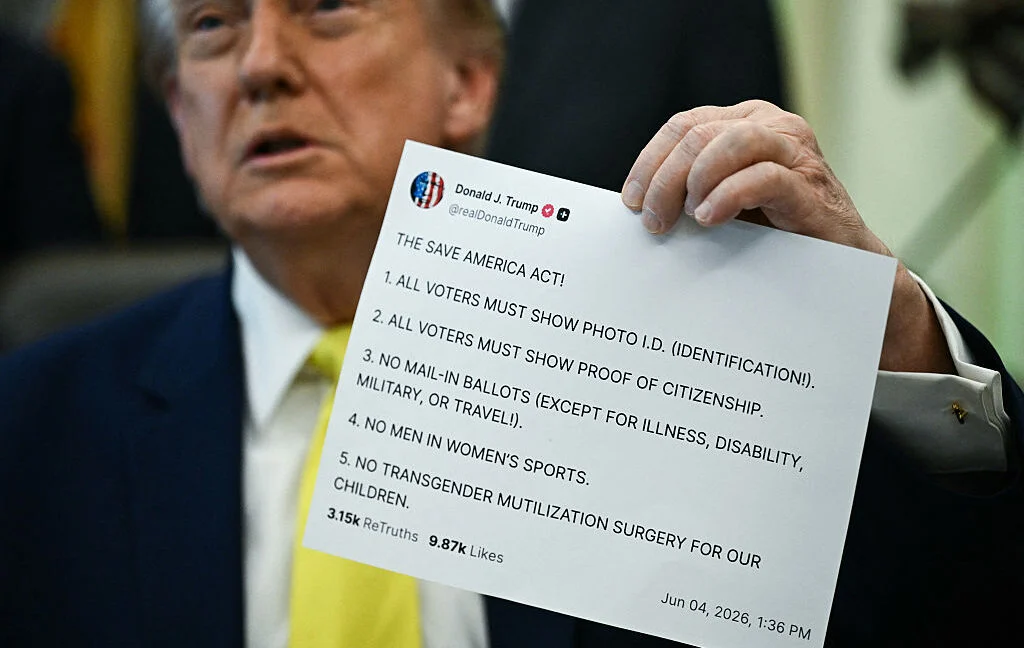
In the coming weeks, a federal court is expected to deliver a landmark ruling that could redefine the intersection of presidential communication, government transparency, and private profit. At the center of the dispute is an unprecedented legal challenge: whether Donald Trump, in his capacity as president, can leverage his social media platform, Truth Social, to sell early access to official government information for as much as $100,000 per month.
The case, which reached a pivotal moment during a hearing on Wednesday, pits a coalition of news organizations against the Department of Justice (DOJ). The plaintiffs argue that the president’s monetization of his digital presence—specifically through the Truth Social API—creates an exclusionary, pay-to-play environment that undermines fundamental constitutional principles. As the majority owner and largest stakeholder of Trump Media & Technology Group, the president stands to profit significantly from a platform that has increasingly become the primary vehicle for high-stakes administrative announcements, ranging from military operations and ceasefires to sweeping changes in immigration and trade policy.
A Clash of Constitutional Arguments
During the hearing, DOJ civil attorney Brantley Mayers mounted a robust defense of the administration’s practices, asserting that there is no conflict of interest in charging exorbitant fees for automated access to the president’s posts. Mayers contended that the president’s personal social media feed serves as a public service, providing unvarnished insights into the executive branch’s decision-making process. According to the DOJ, characterizing these efforts as a "profit grab" ignores the reality that the president’s use of Truth Social is fundamentally an act of modern governance, comparable to the historical precedents set by past administrations.
However, the news groups seeking to strike down the fee structure tell a very different story. In their legal filing, the plaintiffs argue that the current arrangement violates both the First Amendment and the Presidential Records Act. By gatekeeping information that is, by nature and function, public property, the administration is accused of creating tiered access that discriminates against smaller outlets and the broader public.
The legal challenge also invokes the Fifth Amendment, arguing that the government is imposing unreasonable costs that cannot be justified by the actual expense of providing the API service. The plaintiffs assert that granting preferential access to crucial government information for arbitrary and irrational financial reasons constitutes a breach of the government’s obligation to operate transparently and equitably. Because these posts contain vital administrative updates—including announcements on tariffs and national security—the plaintiffs argue that the information itself is public record, and therefore should not be restricted behind a six-figure monthly paywall.
Historical Analogies and the Question of "Fireside Chats"
The courtroom debate took a contentious turn when the DOJ attempted to frame the president’s Truth Social activity within a historical context. Mayers famously likened the president’s rapid-fire social media updates to the "fireside chats" of President Franklin D. Roosevelt. In the 1930s and 1940s, Roosevelt used the radio to speak directly to the American people, bypassing traditional media filters to explain policy and provide comfort during the Great Depression and the Second World War.
By positioning the Truth Social feed as the modern equivalent of these iconic radio broadcasts, the DOJ sought to characterize the president’s digital presence as an essential, democratic tool. Mayers suggested that the president’s, and by extension his company’s, decision to charge for API access was not a departure from transparency, but rather a reflection of the inherent costs of distributing information.
The comparison, however, faced immediate and sharp skepticism from US District Judge Paul Oetken. In a moment that signaled the judge’s focus on the distinction between historical rhetoric and modern monetization, Oetken interrupted the DOJ’s argument to pose a direct question: "Well, President Roosevelt didn’t charge money for his fireside chats, did he?"
The question cut to the core of the plaintiffs’ concerns. While Roosevelt’s fireside chats were broadcast freely over the airwaves, the current administration’s model relies on a proprietary API that extracts significant revenue from the entities seeking to monitor the government’s activities in real-time.
The Limits of "Barriers to Entry"
In response to Judge Oetken’s query, Mayers attempted to bridge the gap between 1930s radio and 2026 social media by arguing that there have always been "barriers to entry" regarding access to the president. He noted that in the early 20th century, not every American owned a radio, and yet the fireside chats were still considered a broad public service. By this logic, Mayers suggested that the high cost of the Truth Social API—ranging from $60,000 to $100,000—should not be viewed as a constitutional barrier, but rather a contemporary limitation similar to the technological gaps of the past.
The plaintiffs’ attorneys have countered this by pointing out that the comparison is fundamentally flawed. In the era of the fireside chats, the barrier was a lack of technology, not an intentional, government-sanctioned paywall designed to enrich the president. They argue that the current scheme allows the president to personally profit—potentially up to $1.2 million annually per subscriber—from the sale of government information that he does not technically own.
As the case progresses, the court must grapple with the evolving nature of public records in the digital age. If the president uses a private platform to conduct public business, does the public have a right to that information without a prohibitive financial cost? The plaintiffs argue that the current fee structure effectively privatizes the executive branch’s communications, forcing news organizations to subsidize the president’s private business interests in order to perform their duty of reporting on government actions.
Implications for Transparency and Oversight
The outcome of this case will likely have far-reaching implications for how future administrations interact with social media platforms and the press. If Judge Oetken rules in favor of the news organizations, it could force a significant restructuring of how the administration distributes its official statements, potentially ending the practice of monetizing API access. Conversely, a ruling that sides with the DOJ could set a precedent that allows future presidents to utilize their personal business interests as conduits for government information, provided they maintain the argument that such access is a form of "modern public service."
The legal arguments presented by both sides highlight a growing tension between the executive branch’s desire for control over its narrative and the public’s right to unfettered access to government decision-making. With the president as the majority owner of the platform in question, the financial incentives are inextricably linked to the flow of information. The court is now left to determine whether this arrangement is a legitimate exercise of executive authority or an unconstitutional encroachment on the public’s right to access government information.
As the hearing concluded, the atmosphere in the courtroom underscored the gravity of the situation. Both parties have laid out their positions: the DOJ maintains that the president’s digital platform is an essential tool for direct communication, while the plaintiffs insist that the Constitution does not permit the government to turn transparency into a luxury commodity. With the judge’s ruling expected in the coming weeks, the case remains a focal point for media groups, constitutional scholars, and the general public, all of whom are waiting to see where the court will draw the line between the president’s role as a public servant and his interests as a private entrepreneur.






No comments yet. Be the first to join the conversation!