

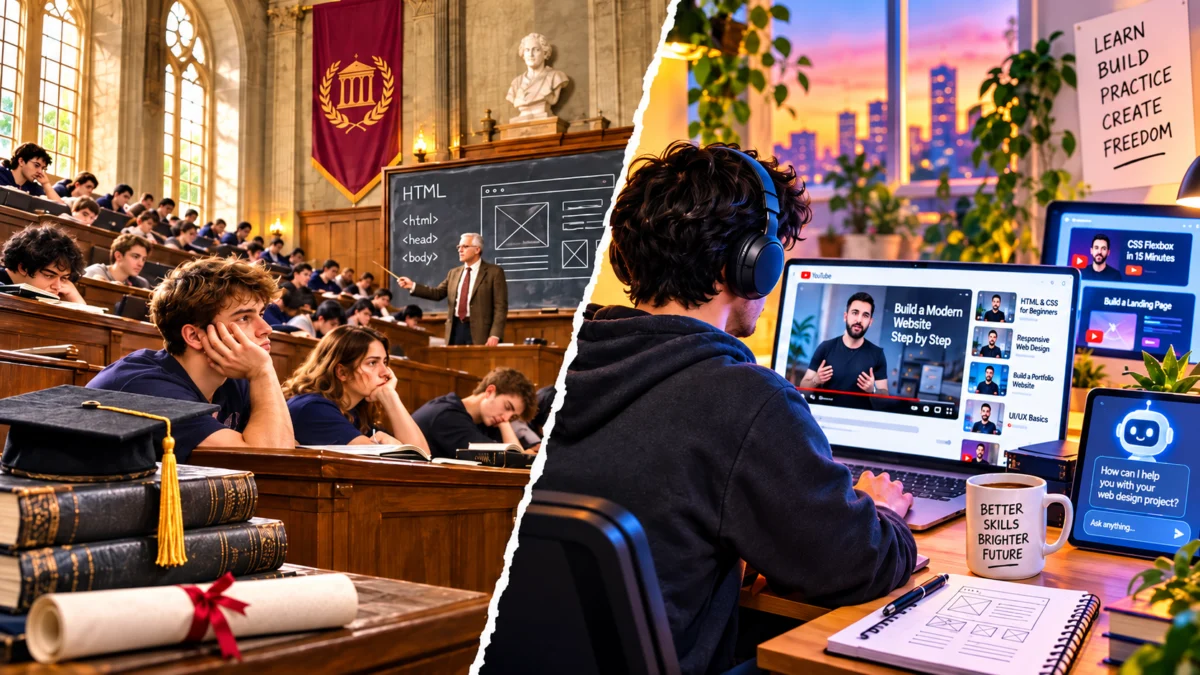
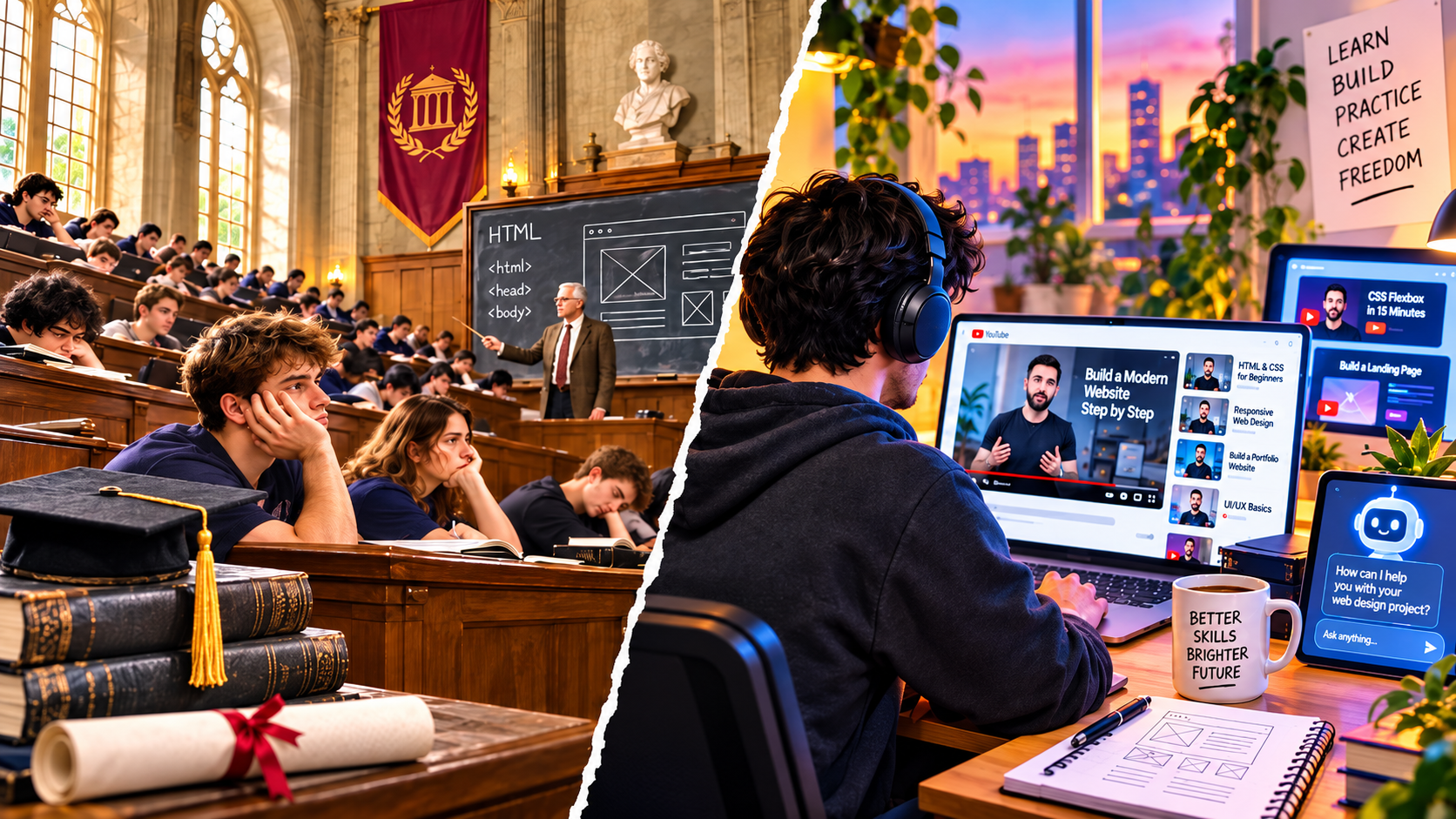
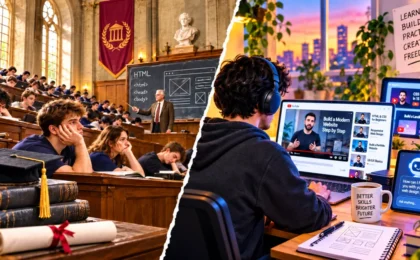
If you wanted to become a professional web designer or developer fifteen years ago, enrolling in a formal academic institution made complete sense. Aspiring digital creators relied on structured school environments to learn the foundational pillars of the web, including HTML, CSS, Photoshop, typography, and user experience (UX) design. These subjects felt mysterious and inaccessible to the general public, locked behind classroom doors and expensive textbooks curated by academic faculties.
Today, the pathway into the digital design industry looks entirely different. An aspiring designer needs little more than an internet connection and access to YouTube.
Want to master Figma? Thousands of comprehensive video tutorials are available instantly. Need to understand CSS Grid? Students can pick their favorite online educator from a global roster of experts. Accessibility standards, responsive design frameworks, and advanced JavaScript concepts are routinely broken down into free, bite-sized courses. When a student encounters a roadblock or struggles to understand a complex technical concept, modern artificial intelligence tools like ChatGPT and Claude are available around the clock to provide instant explanations, review lines of code, pinpoint exact syntax errors, and walk users through the debugging process step-by-step.
This phenomenon has given rise to what many in the tech community call "YouTube University." The tuition cost is effectively zero, and traditional higher education institutions are facing an unprecedented challenge to their value proposition.
YouTube University Moves a Lot Faster
The fundamental friction between traditional academia and modern technology lies in their respective speeds. Universities are deliberately designed to move slowly, maintaining rigorous bureaucratic processes for curriculum approval, peer review, and administrative oversight. A standard university course can take many months or even years to draft, approve, and officially integrate into a degree program.
By contrast, the web moves at breakneck speed. When a new design tool, framework update, or artificial intelligence capability emerges, industry practitioners often publish detailed video tutorials and walkthroughs before a traditional student has finished their morning coffee.
Artificial intelligence has widened this already significant gap. While YouTube delivers the initial lesson, generative AI functions as a tireless, personalized tutor tailored to the individual learner’s pace. Students can ask follow-up questions, request progressively simpler explanations for difficult concepts, paste broken code directly into a prompt, or build experimental projects and immediately ask why they are failing to render properly.
Students have already embraced this shift on a massive scale. According to the 2026 HEPI Student Generative AI Survey, an overwhelming 95 percent of surveyed UK undergraduates reported using artificial intelligence in some capacity for their studies.
For modern educational institutions, the debate over whether students should utilize artificial intelligence in the classroom is effectively over. Students are already using it, integrating it seamlessly into their everyday learning workflows whether their professors formally endorse it or not.
Then There Is the Uncomfortable Question: Why Pay?
This rapid democratization of knowledge forces a difficult and often uncomfortable financial question for prospective students: why pay tens of thousands of dollars for a degree when the information is freely available?
Under the traditional model, a student might spend four years earning a bachelor’s degree while incurring significant financial debt. Meanwhile, an ambitious autodidact can spend those exact same years consuming high-level tutorials from seasoned designers and developers on YouTube, leveraging AI as an on-demand mentor, and actively building live websites for real-world portfolios. Eventually, both individuals may find themselves competing for the exact same entry-level job openings at digital agencies and tech companies.
This dynamic creates an acute challenge within web design and development, where hiring managers and creative directors rely heavily on tangible proof of skill rather than institutional pedigree. According to data from the U.S. Bureau of Labor Statistics, web developers and digital designers frequently do not require specific educational credentials if they can adequately demonstrate their technical abilities, problem-solving skills, and creative execution through verifiable projects, case studies, and professional experience.
When a compelling portfolio speaks louder than a diploma, prospective students are increasingly forced to reevaluate what premium tuition is actually purchasing.
YouTube University Has a Problem Too
Despite its incredible accessibility and speed, YouTube University is not without its own systemic flaws. While YouTube can teach almost anything, it is notoriously terrible at guiding learners on what they should learn.
Self-directed learners frequently fall into rabbit holes of fragmented content. A student might watch a twenty-minute tutorial on CSS animations, pivot immediately to an introductory AI prompt-engineering course, spend two hours watching an influencer redesign Spotify, discover Webflow development, and ultimately end up distracted by sensationalized videos promising rapid, effortless mastery of emerging tech tools.
Nobody forces an independent learner to study crucial, yet unglamorous, topics like web accessibility compliance when they would much rather spend their time building flashy, complex visual animations. Without structured oversight, there is often no one to critically evaluate their work, point out structural flaws in their design logic, or correct bad habits. Consequently, self-taught individuals can become surprisingly capable at surface-level execution while retaining massive, hidden gaps in their fundamental knowledge.
Artificial intelligence shares a parallel weakness. Large language models will enthusiastically help a user build a deeply flawed, insecure, or poorly designed application if the user lacks the foundational expertise required to recognize that the output is substandard.
This exact vulnerability represents the greatest opportunity for traditional universities to reclaim their relevance.
Stop Competing With YouTube
There is little strategic sense in charging students exorbitant tuition fees to sit in a lecture hall absorbing information they could easily consume via a high-quality online video during their evening commute.
Instead, modern universities should pivot toward offering the critical infrastructure that online tutorials inherently lack: dedicated mentors, rigorous and honest critiques, collaborative group projects, and structured academic discipline. Institutions should challenge students to actively defend their design decisions, test live websites on diverse groups of real human users, and master the foundational principles of psychology, typography, user experience, and accessibility—including all the tedious, unglamorous fundamentals that video tutorials make easy to skip over.
Crucially, universities must stop banning or restricting generative AI and instead integrate it intelligently into the curriculum. Rather than spending a grueling week manually writing boilerplate code for a basic website from scratch, students could use AI to generate the initial structural framework and then spend that week critically analyzing the code’s deficiencies. They can focus on making the output faster, more secure, more accessible, structurally original, and genuinely useful to human end-users.
The primary objective of higher education must shift from teaching students how to produce routine digital assets to teaching them how to think critically, solve complex problems, and adapt to continuous technological change.
Universities Are Starting to Get It
Forward-thinking institutions are already beginning to recognize this necessary evolution and are actively restructuring their academic frameworks.
The University of Victoria recently undertook a comprehensive overhaul of its computer-science curriculum, deliberately weaving artificial intelligence integration throughout the entirety of its programs rather than relegating it to an optional, siloed elective course.
Similarly, the University of British Columbia has introduced progressive changes to its science curriculum designed to prepare undergraduates for an AI-driven professional future. These updates include specific coursework focused on evaluating, selecting, and critically assessing the outputs generated by various artificial intelligence platforms.
These institutional shifts represent a step in the right direction. Rather than living in fear of YouTube University and generative technology, forward-thinking academic programs are recognizing that they must offer distinct value that independent online platforms cannot replicate.
The New Competition
A traditional web-design degree is no longer simply competing against alternative academic programs. It is now competing directly with YouTube, advanced artificial intelligence subscriptions, and several years of hands-on project execution. This combined alternative represents a formidable and increasingly polished pathway into the tech industry, improving continuously with every passing month.
Even so, traditional educational institutions still retain access to valuable resources: structured learning pathways, experienced human mentorship, constructive professional critique, collaborative peer networks, and the deep, foundational theoretical knowledge that independent learners frequently bypass when rushing toward quick results.
Ultimately, these are the exact elements that students should be paying premium tuition to receive—not recycled lectures full of basic technical information that is already freely accessible online. The future of digital education will likely belong neither to rigid traditional universities nor entirely to unstructured online tutorials, but rather to the forward-thinking institutions capable of adopting the best aspects of both models.
If a modern design school or university fails to offer a transformative educational experience that clearly surpasses what a motivated student can assemble using free online videos and an AI subscription, those students have every right to question the true value of their investment.







No comments yet. Be the first to join the conversation!