

When cloud engineers and virtualization specialists embark on the complex journey of migrating traditional virtual machines to modern cloud environments, they frequently hit a familiar architectural wall. For years, the core challenge has centered on a deceptively simple networking question: how does an administrator route network traffic directly to a Red Hat OpenShift Virtualization guest virtual machine using that specific machine’s native IP address?
OpenShift Virtualization has long offered robust answers to this networking riddle through features like localnets, provided that the underlying cluster operates on an on-premise Layer 2 network architecture. However, public cloud infrastructure providers typically operate differently, exposing only Layer 3 networking constructs to their customers. This fundamental architectural discrepancy has historically forced organizations utilizing OpenShift Virtualization in cloud environments to radically redesign their underlying networking strategies.
Without the capability for direct IP routing within the cloud, engineering teams were compelled to treat traditional virtual machines much like containerized workloads. This workaround required administrators to implement NodePort Services and specialized Routes, a process that ultimately obscured the virtual machines’ actual IP addresses and added unnecessary layers of operational complexity.
To address these long-standing architectural constraints, Red Hat is introducing a new solution: the BGP cloud connector. Launching specifically for Red Hat OpenShift Service on AWS (ROSA) on cluster versions 4.22 or later, this development aims to bridge the gap between cloud-native container platforms and traditional enterprise virtualization requirements. The BGP cloud connector empowers customers to route traffic seamlessly between an in-cluster overlay network—formally known as a ClusterUserDefinedNetwork, or CUDN—and the virtual private cloud (VPC) in which the OpenShift cluster actually resides.
Once this connection is established, organizations can easily link their VPC directly to broader corporate enterprise networks using established Amazon Web Services solutions, such as AWS Transit Gateway or AWS Direct Connect. By leveraging these native tools, virtualization teams can achieve comprehensive, end-to-end connectivity between any of their corporate networks and individual guest virtual machines hosted within a Red Hat OpenShift Service on AWS cluster.
Expanded Workload Possibilities

The introduction of the BGP cloud connector significantly broadens the horizons for what organizations can achieve when running virtualized workloads in the cloud. Because individual guest virtual machines can now retain their native IP addresses externally, many of the traditional networking challenges that have plagued cloud migrations now encounter straightforward, native solutions.
Historically, applications dependent on hardcoded IP addresses, specific inbound connection ports, or complex legacy communication patterns required extensive re-architecting before they could safely move to a managed cloud service. With direct IP routing enabled by Border Gateway Protocol integration, these legacy constraints are vastly reduced. Virtual machines can now participate in enterprise routing topologies as first-class citizens, possessing their own recognizable network identities rather than hiding behind network address translation or complex proxy layers.
To demonstrate how the BGP cloud connector operates in a live environment, consider a practical scenario where an Amazon EC2 instance residing within a standard VPC communicates directly with a virtual machine running inside a Red Hat OpenShift Service on AWS cluster, completely bypassing network address translation.
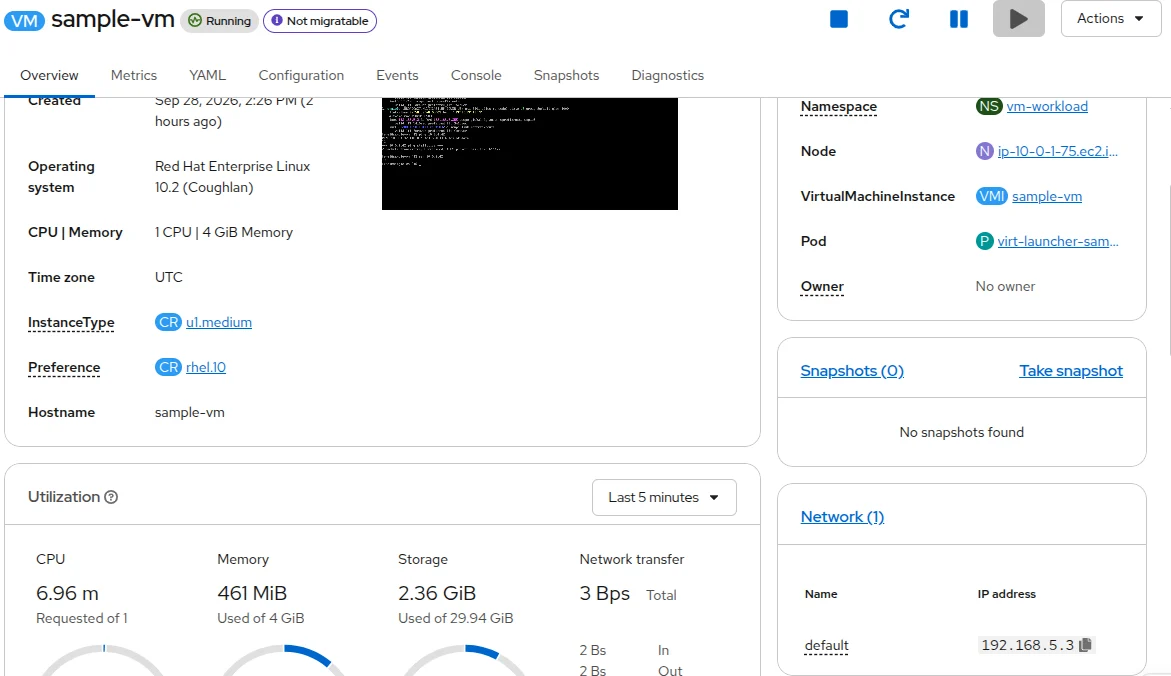
In a typical deployment, a virtual machine guest within the cluster is assigned a specific IP address—for instance, 192.168.5.3—drawn from a ClusterUserDefinedNetwork that the BGP cloud connector has explicitly configured the surrounding VPC to route toward. Administrators running interactive services, such as a specialized command-line assistant chatbot listening on port 8000 within that guest virtual machine, can observe the direct binding through standard networking utilities.
When an engineer logs into a separate EC2 instance located within the exact same VPC, they are able to initiate a direct connection to the virtual machine’s specific port and IP address without encountering routing barriers. Interacting with the application confirms that traffic flows cleanly and directly across the boundary between the AWS infrastructure and the internal cluster overlay network, fulfilling the promise of transparent, native IP communication in the cloud.
How BGP Cloud Connector Works
Understanding the mechanics behind this capability reveals a sophisticated integration of standard routing protocols and cloud networking primitives. In a Red Hat OpenShift Service on AWS cluster utilizing this new feature, the cluster worker nodes serve a critical dual purpose, acting effectively as routers for traffic moving back and forth between the broader VPC and the ClusterUserDefinedNetwork where the guest virtual machines reside.

The underlying cluster achieves this by utilizing the Border Gateway Protocol, a standardized exterior gateway protocol designed to exchange routing and reachability information. The cluster leverages BGP to actively advertise specific network routes directly to the Amazon VPC Route Server, which in turn dynamically updates those paths within the appropriate VPC route tables. As worker nodes dynamically join or leave the OpenShift cluster over time, the BGP cloud connector continually updates the set of Route Server peers, ensuring high availability and accurate routing state without manual intervention.
Each advertised route configures the surrounding VPC to direct any incoming traffic destined for the ClusterUserDefinedNetwork’s specific IP range straight to one of the cluster’s active worker nodes. That initial worker node then efficiently forwards the traffic onward to the specific worker node that is actively hosting the target virtual machine guest. Because standard VPC route tables contain a single route per IP prefix at any given moment, the Route Server selects one specific route to publish at a time. This means that a designated worker node acts as the primary router for incoming traffic directed toward a particular ClusterUserDefinedNetwork during normal operations.
Resiliency is built directly into this architectural design. If the active gateway node unexpectedly drops offline or experiences a failure, the Amazon VPC Route Server quickly detects the disruption over the BGP session. The system then automatically updates the VPC route table to point toward a healthy, available worker node, ensuring that virtual machine traffic continues to flow with minimal interruption.
Getting Started
For enterprise architectures that strictly require direct, unhindered connectivity to the IP addresses of virtual machines running in the cloud, adopting the new tooling represents a streamlined path forward. Organizations interested in implementing this capability can consult Red Hat’s comprehensive product documentation for detailed, step-by-step guidance on how to properly set up their virtual private cloud, install and configure the necessary operator, and successfully deploy their first directly addressable virtual machine.
For teams that have not yet established a Red Hat OpenShift Service on AWS environment, introductory resources including the official quickstart guide and structured learning paths provide a clear entry point into managed cloud container and virtualization platforms. Furthermore, technical webinars and educational resources offered by Red Hat explore the nuances of OpenShift Virtualization networking, providing deeper insights for IT professionals seeking to unify their virtual machine and container operations onto a single, cohesive platform.












No comments yet. Be the first to join the conversation!