

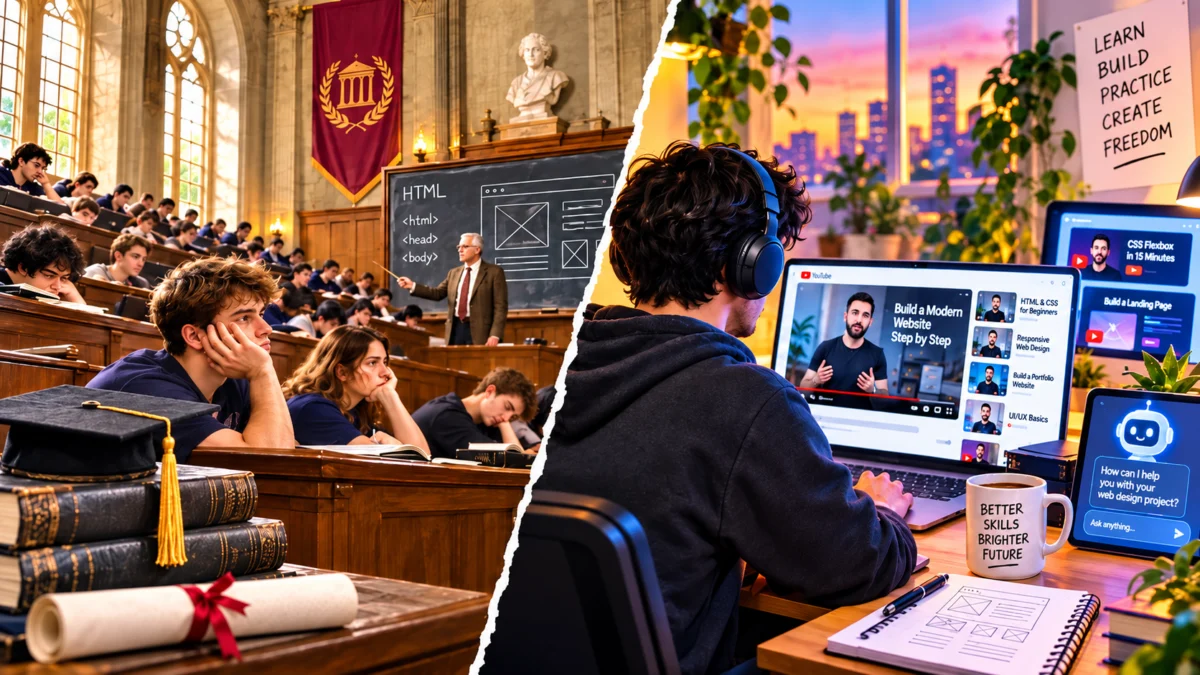
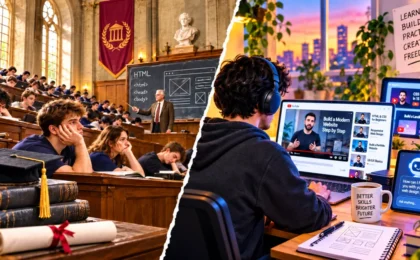
Fifteen years ago, aspiring to become a web designer or developer meant navigating a straightforward, if expensive, educational path. Enrolling in a traditional school or university was practically a prerequisite. Students relied on instructors to demystify HTML, CSS, Adobe Photoshop, typography, user experience (UX) design, and the myriad other complex disciplines that governed the early internet.
Today, the modern digital craftsman’s journey looks entirely different. Prospective designers can bypass campus admissions entirely and simply open YouTube.
The digital landscape offers a decentralized, peer-produced curriculum that moves at the speed of the internet. Want to master Figma? Thousands of comprehensive tutorials are available at the click of a button. Need to understand CSS Grid? Learners can browse content from a vast selection of educators to find a teaching style that suits them. Comprehensive accessibility guidelines, backend logic, and framework architectures are broken down into free courses. When a concept proves elusive, generative artificial intelligence tools like ChatGPT or Claude can act as instantaneous, round-the-clock teaching assistants. These models can explain complex codebases, inspect syntax line-by-line to pinpoint errors, and patiently clarify the underlying mechanics of what went wrong.
Welcome to YouTube University, where tuition is essentially zero, and traditional higher education faces an unprecedented structural crisis.
YouTube University Moves a Lot Faster
The fundamental friction point between traditional academia and modern tech education lies in velocity. Universities inherently move slowly, burdened by administrative oversight, bureaucratic accreditation processes, and multi-year curriculum review boards. The web, by contrast, changes daily.
A traditional university course can take months or even years to clear approval and update cycles. In the fast-paced world of digital design and software engineering, when a new framework, design tool, or revolutionary artificial intelligence feature emerges, independent educators have often uploaded comprehensive walkthroughs before a student has finished their morning coffee.
Artificial intelligence has widened this agility gap even further. While YouTube provides the foundational lesson, large language models provide something approximating a personalized tutor. Students can ask follow-up questions, request progressively simpler explanations, paste in broken code blocks, or experiment with a design and immediately ask why it fails to function as intended.
This shift is no longer a fringe phenomenon; students have embraced it on a massive scale. According to the 2026 HEPI Student Generative AI Survey, an overwhelming 95% of surveyed UK undergraduates reported using artificial intelligence in some capacity for their studies. Universities are no longer debating whether students should incorporate AI into their learning process—students have already decided for them.
Then There Is the Uncomfortable Question: Why Pay?
This rapid democratization of knowledge forces an uncomfortable reckoning for higher education: why pay tens of thousands of dollars for a degree when the same information is available for free?
Consider the parallel timelines of two aspiring professionals. One person spends years earning a traditional computer science or digital arts degree, accumulating significant debt. Simultaneously, another person spends those exact same years consuming content from elite designers and developers on YouTube, leveraging AI tools as private mentors, and actively building live websites and applications. Eventually, both individuals may find themselves applying for the exact same entry-level position.
This dynamic is particularly pronounced in web design and development, where the industry places a heavy premium on empirical proof of skill over institutional credentials. According to data from the U.S. Bureau of Labor Statistics, web developers and digital designers frequently do not need specific educational credentials if they can comprehensively demonstrate their technical and creative abilities through tangible projects and real-world experience.
When a portfolio of functional, beautiful, and accessible websites speaks loudly enough to secure employment, students are naturally prompted to ask what exactly they are paying their tuition fees to receive.
YouTube University Has a Problem Too
Despite its undeniable advantages, YouTube University possesses its own critical vulnerabilities. While the platform can teach almost anything, it is notoriously poor at teaching students what they should learn.
Autodidacts are all too familiar with the rabbit hole of self-directed study: watching a CSS animation tutorial, pivoting abruptly to an algorithmic AI course, spending two hours watching a senior designer redesign Spotify from scratch, discovering Webflow, and ultimately getting sidetracked by sensationalized clickbait videos promising hidden shortcuts.
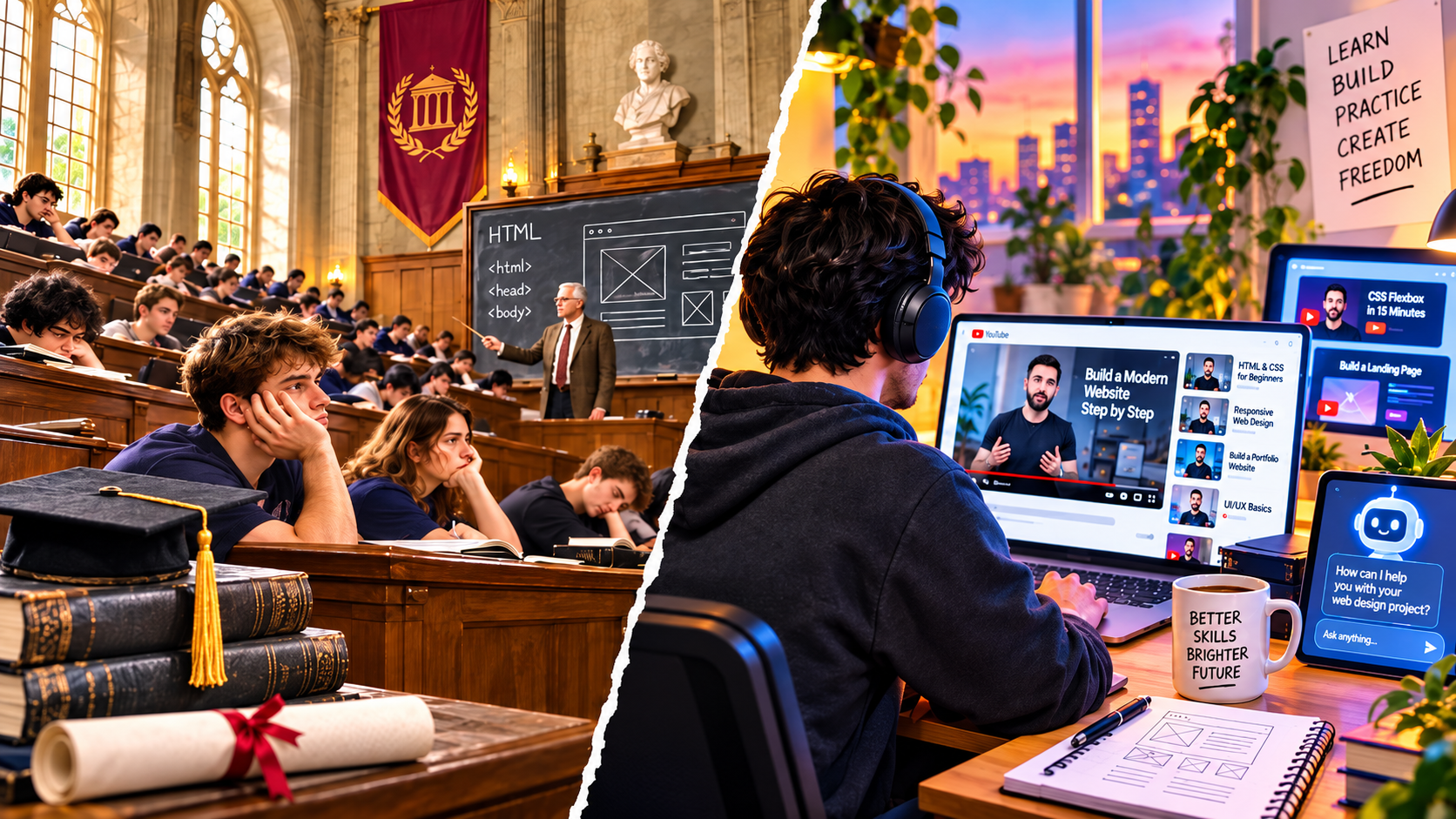
In a completely open ecosystem, no mandatory syllabus forces a student to learn essential but unglamorous topics like digital accessibility, color theory, or semantic markup when they would rather spend their time building flashy animations. There are no mandatory studio critiques where experienced professionals tear down weak design choices. Consequently, self-taught learners can become surprisingly capable at executing specific tasks while maintaining enormous, foundational gaps in their overall knowledge base.
Artificial intelligence shares a similar systemic weakness. An AI model will enthusiastically help a user build something deeply flawed if the user lacks the foundational expertise required to recognize that the output is substandard.
And that precise vulnerability represents the ultimate opportunity for traditional universities to reinvent their value proposition.
Stop Competing with YouTube
There is little strategic sense in charging students exorbitant tuition fees to sit in a lecture hall absorbing information they could easily digest from an exceptional YouTube video the night before.
Instead, universities should focus on providing the critical infrastructure that online platforms and standalone tutorials cannot replicate: rigorous mentorship, unvarnished peer critiques, collaborative group projects, and structured academic discipline. Institutions should force students to rigorously defend their design decisions, test live websites on diverse human audiences, and master the foundational pillars of psychology, typography, accessibility, and user experience—including the boring-but-vital concepts that video tutorials make dangerously easy to skip.
Furthermore, academic institutions must embrace artificial intelligence rather than resisting it. Instead of spending a week manually coding a basic, repetitive website from scratch, students could use AI to generate the baseline framework and then spend that week analyzing, critiquing, and debugging the output. The goal should be to make the resulting digital product faster, more accessible, more original, and genuinely useful.
The objective of higher education must shift from teaching students how to produce routine assets to teaching them how to think critically.
Universities Are Starting to Get It
Signs of this necessary evolution are already emerging across the academic landscape.
The University of Victoria has overhauled its computer science curriculum, deliberately integrating artificial intelligence throughout the entire program rather than relegating it to an optional elective or treating it as a taboo subject. Similarly, the University of British Columbia has introduced comprehensive curriculum updates designed to prepare undergraduates for an AI-driven future, instructing students not only on how to select appropriate AI tools but also on how to critically evaluate the validity and safety of what those tools produce.
These institutional shifts point in the right direction. Universities should not view YouTube University as an existential enemy to be banned or ignored; rather, they must redefine their offerings around the distinct elements that digital platforms cannot supply.
The New Competition
A modern web design degree is no longer merely competing against competing degree programs from rival institutions. It is competing against a formidable alternative: YouTube combined with generative artificial intelligence and a few years of autonomous, hands-on building. That alternative is potent, accessible, and improving with every passing month.
Traditional universities still retain access to profoundly valuable assets—structured learning environments, expert mentorship, rigorous critique, peer collaboration, and the deep theoretical knowledge that self-directed learners often overlook in their haste to build.
However, those are the exact components that students should be paying to receive, rather than paying for lectures full of static information that is freely available online. The future of education is unlikely to be an absolute choice between traditional university and YouTube University. Instead, the most adaptable schools will synthesize the best attributes of both worlds.
If a web design or computer science program cannot offer an educational experience demonstrably superior to a curated video playlist and an AI subscription, students will continue to question the true return on their investment.




No comments yet. Be the first to join the conversation!