

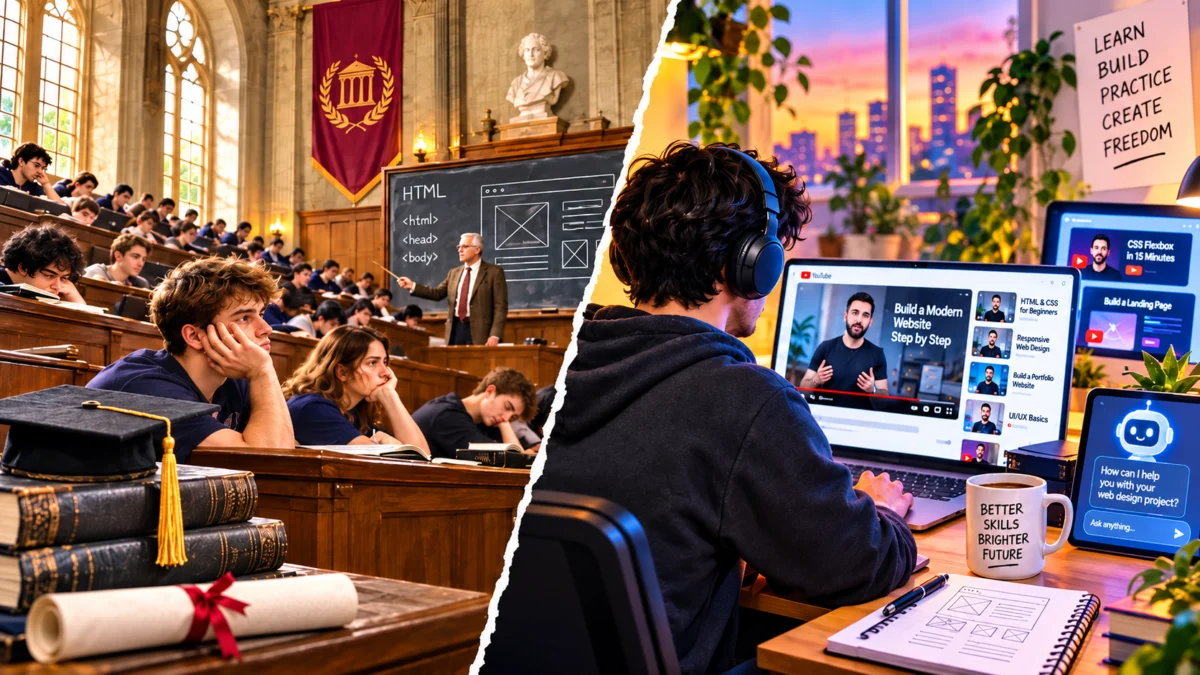
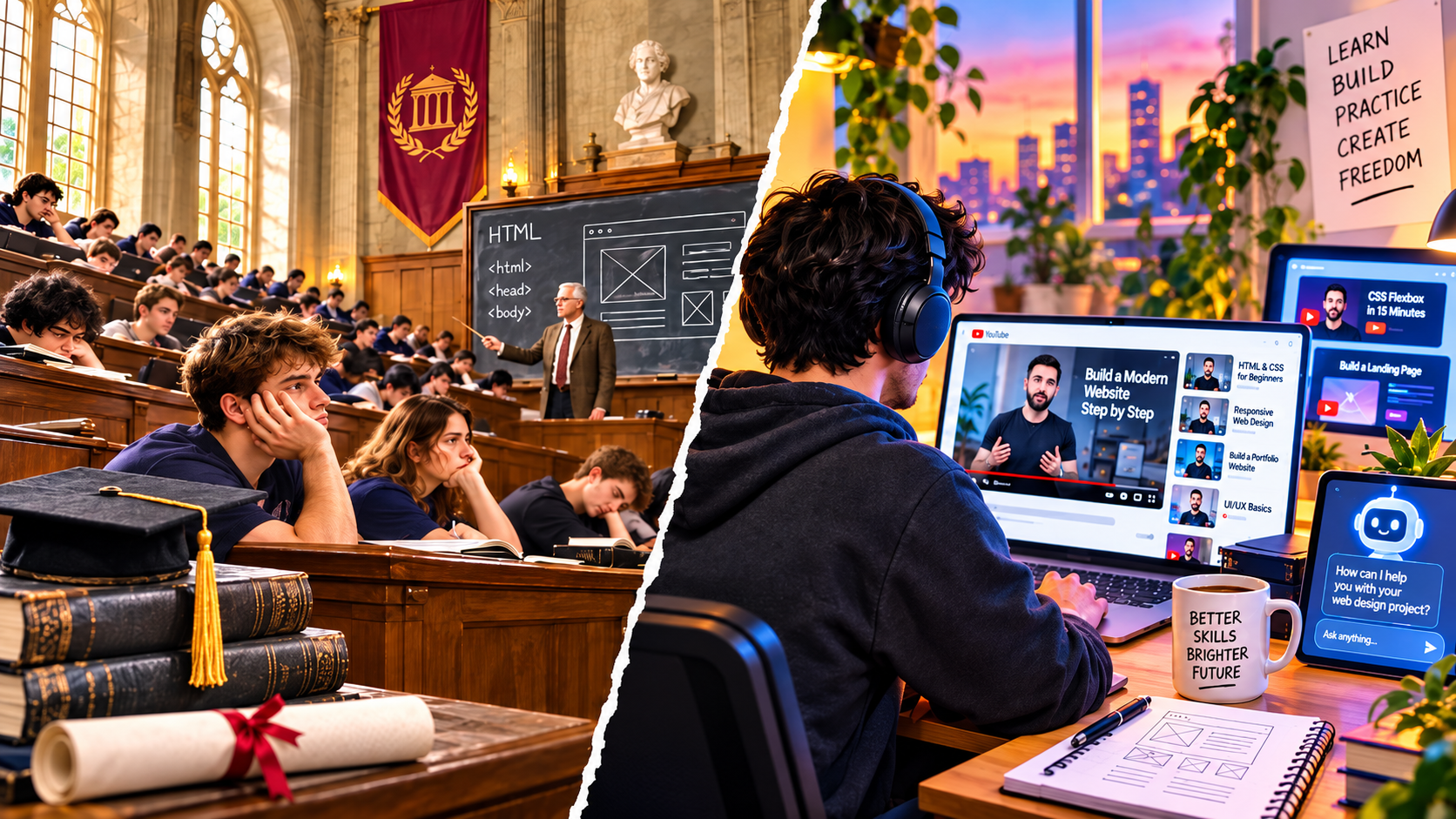
If you wanted to become a web designer fifteen years ago, enrolling in a traditional educational institution made a logical and practically mandatory kind of sense. Aspiring digital creators needed a formal instructor to teach the foundational architecture of the internet, walking them step-by-step through HTML, CSS, raster graphics editing in Photoshop, typography principles, user experience (UX) methodologies, and all the other esoteric skills that separated internet professionals from casual hobbyists. The path to a career in digital design was paved with tuition fees, semester-long syllabi, and physical classrooms.
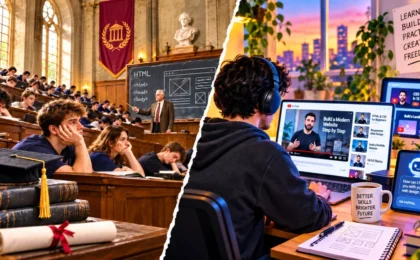
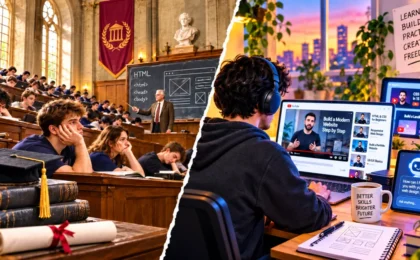
Today, the modern digital craftsman’s journey looks radically different. The primary portal of education is no longer a lecture hall amphitheater, but a browser window directed at YouTube.
Aspiring designers who want to master interface design tools like Figma can choose from thousands of comprehensive, up-to-date video tutorials created by working industry professionals. If they need to understand complex layout systems like CSS Grid, they can browse dozens of masterclasses and pick a teacher whose communication style matches their learning preferences. Crucially, vital industry standards like web accessibility are no longer locked behind expensive textbooks; entire specialized courses covering inclusive design are available for free to anyone with an internet connection. When a learner hits a wall or cannot comprehend a piece of syntax, they do not have to wait for office hours. They can simply ask artificial intelligence models like ChatGPT or Claude to explain the concept, review their source code line by line, pinpoint exact mistakes, and clarify the logic behind what went wrong.
This decentralized ecosystem has become affectionately and accurately known as "YouTube University." Its tuition cost is effectively zero, and its rapid ascendance has left traditional colleges and universities facing a profound identity crisis.
YouTube University Moves a Lot Faster
The fundamental friction point between traditional academia and the modern digital landscape comes down to velocity. Universities inherently move slowly. They operate through bureaucratic committees, academic senate approvals, and curriculum updates that can take months or even years to clear administrative hurdles.
The web, conversely, moves at breakneck speed.
When a brand-new software tool, design methodology, or groundbreaking artificial intelligence capability hits the market, independent creators and industry practitioners have usually uploaded high-quality tutorial content explaining it before a university professor has even finished their morning coffee. The integration of generative artificial intelligence has widened this adaptation gap into a chasm. While YouTube provides the instructional lesson, modern AI tools act as an always-available personal tutor. Students can ask infinite follow-up questions, request progressively simpler explanations for abstract concepts, paste in broken scripts, or build prototypes and instantly query why a specific interaction fails to render correctly.
Higher education institutions can no longer afford to ignore this shift, because their students have already embraced it wholesale. According to the 2026 HEPI Student Generative AI Survey published by the Higher Education Policy Institute, an overwhelming 95% of surveyed undergraduate students in the United Kingdom were already utilizing artificial intelligence tools in some capacity for their academic pursuits.
For modern colleges, the debate over whether students should be allowed or encouraged to learn with artificial intelligence is effectively over. The students made that decision long ago; the only question remaining is how higher education intends to respond.
Then There Is the Uncomfortable Question: Why Pay?
This digital revolution introduces a stark and deeply uncomfortable question for prospective students and parents alike: Why pay exorbitant tuition fees when the knowledge is free?
Consider the alternative trajectories available to two ambitious individuals entering the workforce. One person spends four years and tens of thousands of dollars earning a formal degree, navigating general education requirements and administrative bureaucracy. Simultaneously, another person spends those exact same years consuming elite tutorials from working designers and developers on YouTube, leveraging advanced artificial intelligence as a responsive tutor, and actually building functional, live websites for real clients or personal portfolios.
Eventually, both candidates may find themselves applying for the exact same entry-level web development or digital design position.
This scenario creates a uniquely awkward challenge for traditional web design programs because the tech industry is uniquely meritocratic and output-driven. Employers do not merely look at a framed diploma hanging on a wall; they evaluate what a candidate has actually built. Data from the U.S. Bureau of Labor Statistics indicates that web developers and digital designers frequently do not need specific educational credentials if they can comprehensively demonstrate their technical abilities, creative vision, and problem-solving skills through tangible projects and proven experience.
When a meticulously crafted professional portfolio speaks volumes about a candidate’s capabilities, the value proposition of a traditional degree becomes murky. What exactly are contemporary students paying tens of thousands of dollars for?
YouTube University Has a Problem Too
Despite its democratization of knowledge, YouTube University is far from a flawless institution. While it can teach an individual almost any isolated technical skill imaginable, it suffers from a critical structural flaw: it is notoriously terrible at telling learners what they should actually study.
Self-directed learners frequently fall into chaotic rabbit holes. A student might watch a twenty-minute tutorial on CSS animations, pivot immediately to an advanced artificial intelligence workflow course, spend two hours watching a popular creator redesign the Spotify desktop interface, discover Webflow development, and ultimately find themselves hypnotized by algorithmic recommendations watching a video titled 10 INSANE AI Tools You Won’t Believe Are FREE.
Anyone who has ever tried to teach themselves a technical discipline online recognizes this trap.
In a purely self-directed environment, no instructor forces a student to learn the nuances of web accessibility when they would much rather spend their afternoon crafting flashy, high-performance UI animations. There is no experienced mentor critiquing foundational design errors. Consequently, a self-taught individual can become surprisingly capable at surface-level execution while retaining enormous, potentially career-limiting blind spots in their core knowledge base.
Artificial intelligence shares a parallel vulnerability. Large language models and code assistants will enthusiastically and politely help a user build something fundamentally flawed, insecure, or poorly structured if the user lacks the foundational baseline knowledge required to recognize that the output is substandard.
And that precise pedagogical gap is exactly where traditional universities still possess the potential to win.
Stop Competing with YouTube
There is little logical justification for charging students thousands of dollars in tuition to sit in a lecture hall absorbing information they could easily and comfortably absorb from an exceptional YouTube video during an evening at home.
Instead of trying to replicate content delivery, universities must evolve to offer the critical elements that online video platforms simply cannot provide: world-class mentors, rigorous and honest creative critiques, genuine peer collaboration, and structured accountability. Institutions should force students to rigorously defend their design decisions, test live websites on real human users rather than simulated environments, and master the often-overlooked disciplines of psychology, typography, color theory, and human-computer interaction. They must teach the boring-but-vital fundamentals that online tutorials make easy to skip.
Furthermore, universities need to formally embrace artificial intelligence rather than ban or restrict it.
Rather than assigning students to spend a week manually coding a rudimentary brochure website from scratch, progressive programs should task AI with generating the baseline framework immediately, then spend the entire week having students dissect, audit, and improve upon that machine-made output. Students should be challenged to make the code faster, more accessible, more original, and genuinely useful to human users.
The goal of modern higher education must be to teach students how to think critically, not merely how to produce repetitive artifacts.
Universities Are Starting to Get It
Fortunately, forward-thinking academic institutions are beginning to recognize this operational reality and are restructuring their programs accordingly.
The University of Victoria has taken decisive steps by fundamentally overhauling its computer science curriculum, deliberately integrating artificial intelligence concepts and practices throughout the entire educational program rather than relegating AI to an optional, siloed elective.
Similarly, institutions like the University of British Columbia are actively transforming their academic structures, introducing innovative AI education tracks designed to train undergraduates not just in syntax, but in how to judiciously choose among emerging AI tools and critically evaluate the reliability and quality of what those systems produce.
These curriculum shifts represent a step in the right direction. Universities should not view YouTube University as an existential enemy to be feared or suppressed; instead, they must recognize it as a challenge to elevate their own offerings by providing what online platforms fundamentally lack.
The New Competition
A contemporary web design degree is no longer competing solely against alternative degrees from rival academic institutions. It is competing against a formidable trifecta: YouTube, advanced artificial intelligence, and a few years of autonomous, hands-on building. That alternative pathway is potent, accessible, and improving at an exponential rate every single month.
Traditional universities still retain access to genuinely valuable assets, including structured learning pathways, experienced human mentorship, constructive critique, collaborative studio environments, and the deep theoretical knowledge that self-taught learners frequently bypass in their rush to build functional projects.
However, those structural advantages are precisely what students should be paying for—not introductory lectures full of generalized information that can be readily acquired online for free. The future of design education likely lies neither in pure traditionalism nor in completely unguided self-teaching. The smartest schools will strategically absorb the best elements of both worlds.
Because if a modern web design school or university cannot offer an educational experience demonstrably superior to a curated playlist of YouTube tutorials and an artificial intelligence subscription, students have every right to wonder what, exactly, their tuition is paying for.






No comments yet. Be the first to join the conversation!