

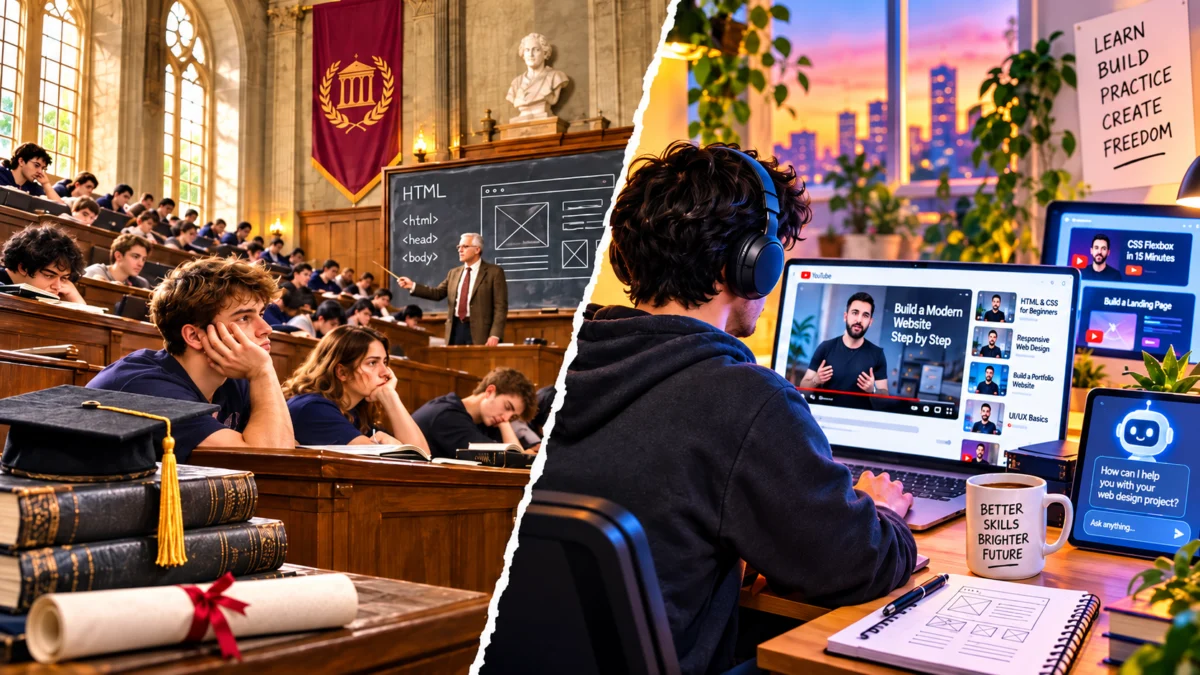
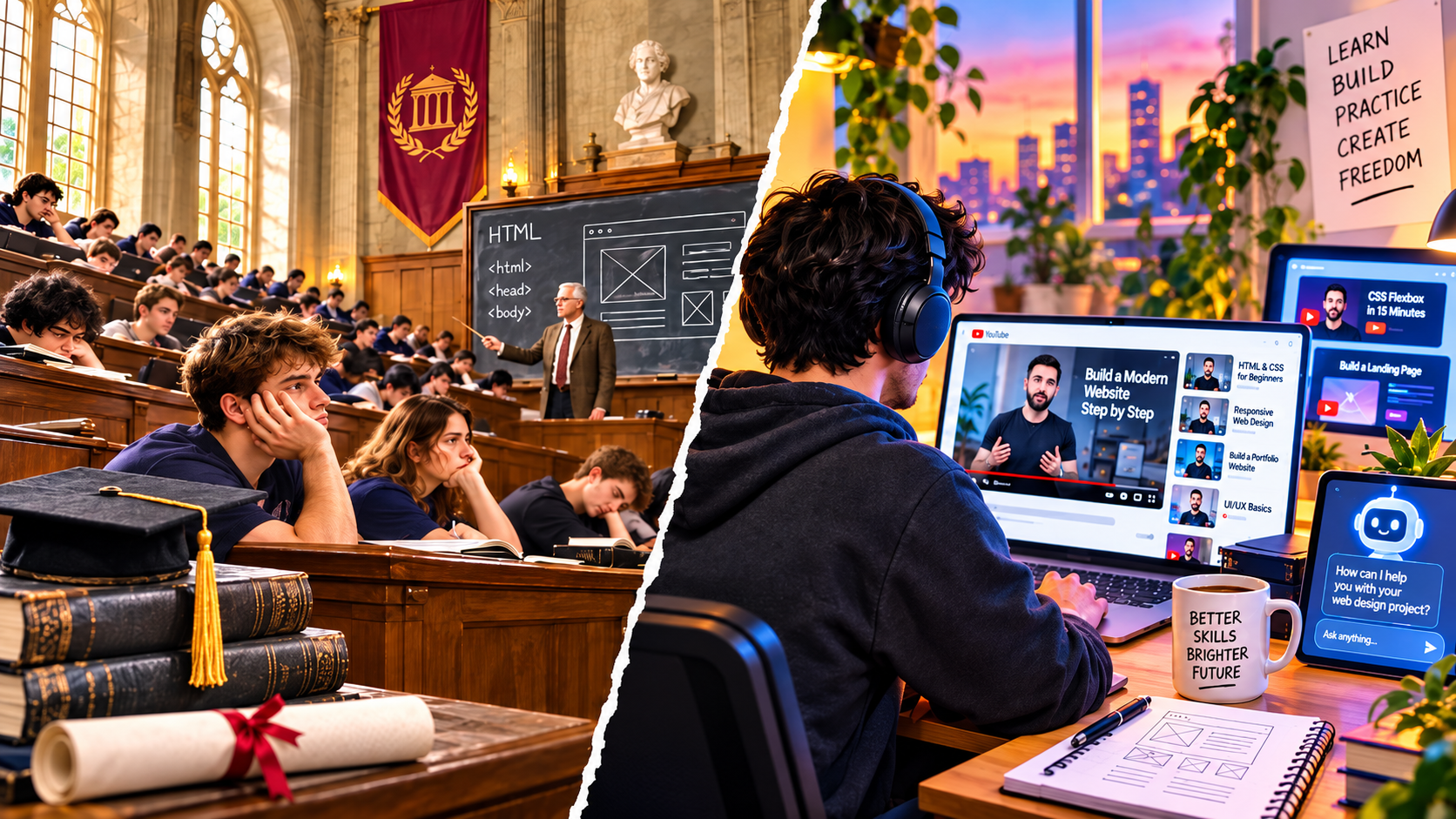
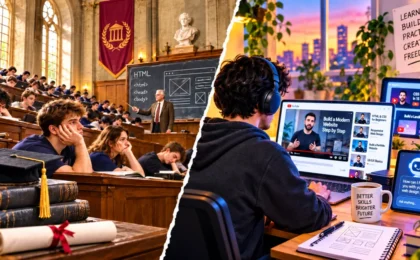
Fifteen years ago, the pathway into the digital design and web development industry was straightforward, if somewhat rigid. If you wanted to build a career creating digital spaces, enrolling in a formal academic institution made intuitive sense. You needed someone standing at the front of a lecture hall to demystify HTML, CSS, Photoshop, typography, user experience (UX) principles, and the myriad other arcane skills required to navigate the early modern internet. A degree or a specialized diploma served as a necessary passport into the workforce, signaling to employers that you had weathered the bureaucratic and intellectual rigor of a structured program.
Today, the aspiring designer faces an entirely different landscape. The modern gateway to the profession is far more decentralized, immediate, and remarkably inexpensive: you simply open YouTube.
Want to master Figma? Thousands of comprehensive, up-to-date tutorials await. Need to get a firm grasp of CSS Grid? You can browse through dozens of expert teachers who specialize in breaking down complex layouts into digestible visual steps. Accessibility standards? Entire educational modules and university-level courses are available to stream for free. If you stumble upon a concept you do not understand, or if your code refuses to compile, you do not have to wait for office hours. You can prompt ChatGPT or Claude to explain the underlying logic, audit your code, identify your exact mistakes, and walk you through the correction process.
Welcome to YouTube University. The tuition is practically zero, and traditional institutions of higher learning are suddenly facing an unprecedented existential crisis.
YouTube University Moves a Lot Faster
One of the most glaring vulnerabilities of traditional higher education is its inherent velocity. Universities are massive, deliberate institutions that move slowly. The web, by contrast, is a hyper-accelerated ecosystem that reinvents itself almost daily.
Under standard academic operating procedures, designing and approving a new university course can take months or even years of committee reviews, curriculum updates, and administrative sign-offs. Conversely, when a new design tool drops or a breakthrough generative AI feature alters the industry standard, independent creators on digital platforms have usually uploaded comprehensive tutorial breakdowns before the morning coffee has even cooled.
Artificial intelligence has widened this competitive gap even further. While YouTube provides the foundational lesson and the visual walkthrough, AI tools provide something that feels remarkably close to a dedicated personal tutor. Students can ask follow-up questions, request simpler analogies, paste in broken code segments, or construct a rough prototype and immediately ask an AI why it fails to function or how it can be optimized.
This shift in student behavior is no longer a fringe movement; it has become the dominant reality of modern learning. The 2026 HEPI Student Generative AI Survey underscores this profound transformation, revealing that an astounding 95% of surveyed UK undergraduates are utilizing artificial intelligence in some capacity for their studies. Universities are no longer in a position to debate whether students should learn with AI. The verdict is already in: students are already doing it, reshaping their own educational journeys outside the traditional boundaries of the lecture hall.
Then There Is the Uncomfortable Question: Why Pay?
This widespread adoption of alternative learning models brings a deeply uncomfortable question to the forefront of modern education: why pay tens of thousands of dollars for a degree when the knowledge is available for free?
Consider the diverging paths of two prospective professionals. One student spends four years and thousands of dollars navigating the general education requirements and administrative overhead of a traditional university degree. Simultaneously, another aspiring creator spends those exact same years studying under top-tier designers and developers on YouTube, leveraging AI as an interactive tutor, and actually building functional websites and real-world projects. Eventually, both individuals find themselves applying for the exact same entry-level position at a digital agency.
This dynamic is particularly pronounced in fields like web design and software development, where theoretical knowledge must ultimately yield tangible output. Employers in the tech and creative sectors do not rely solely on transcripts; they look at what candidates have actually built. According to data from the U.S. Bureau of Labor Statistics, web developers and digital designers often do not require specific educational credentials if they can comprehensively demonstrate their technical abilities, problem-solving skills, and creative execution through a robust portfolio of real-world projects.
When a compelling portfolio speaks louder than a framed diploma, the fundamental value proposition of a university education begins to fray. Students are left asking a blunt question: what exactly are they paying for?
YouTube University Has a Problem Too
For all its accessibility and speed, YouTube University is far from a flawless educational ecosystem. While it can teach you almost anything you want to know, it is remarkably terrible at telling you what you ought to learn.
The self-directed learner is constantly vulnerable to the whims of algorithms and rabbit holes. You might begin by watching a targeted tutorial on CSS layout techniques, quickly pivot to an advanced AI workflow course, spend two solid hours watching a creator redesign Spotify, discover the complexities of Webflow, and finally find yourself clicking on a sensationalized video promising ten insane AI tools you will not believe are free. Anyone who has ever attempted to master a digital skill online recognizes this fragmented, distraction-laden journey.
Furthermore, self-directed learning lacks the friction of accountability. Nobody forces you to master the tedious principles of web accessibility when you would much rather spend your afternoon crafting flashy CSS animations. Nobody sits you down to deliver a rigorous, objective critique of your user interface design. A self-taught student can become surprisingly capable at executing surface-level tasks while still harboring massive, foundational gaps in their overall knowledge base.
Artificial intelligence shares a parallel vulnerability. An AI assistant will enthusiastically help you build something genuinely terrible if you lack the foundational expertise required to recognize that the output is flawed.
And that precise vulnerability is where traditional universities still possess the potential to win.
Stop Competing With YouTube
There is little strategic sense in charging students exorbitant tuition fees to sit in a crowded lecture hall listening to an instructor recite information that an exceptional educator has already distilled into a ten-minute YouTube video available online tonight.
Instead of trying to replicate content delivery, universities should focus on providing the critical elements that algorithmic platforms simply cannot replicate: world-class mentorship, rigorous and constructive critiques, collaborative group projects, and structured accountability. Institutions should force students to rigorously defend their design decisions, test their digital products on real human users, and master the foundational pillars of accessibility, cognitive psychology, typography, and advanced UX theory—including all the boring-but-essential topics that online tutorials make far too easy to skip.
Crucially, universities must stop treating AI as a threat to be banned and instead let students use it deliberately. Rather than spending an entire week manually coding a basic, repetitive website from scratch, students could use AI to generate the baseline architecture and then spend that week dissecting what is wrong with it. They can learn how to make the code faster, more secure, more accessible, more original, and genuinely useful to human users. The goal of higher education must shift from teaching students how to produce routine deliverables to teaching them how to think critically.
Universities Are Starting to Get It
Fortunately, some progressive academic institutions are already recognizing the writing on the wall and adapting their models to the new technological reality.
The University of Victoria has fundamentally overhauled its computer science curriculum, weaving artificial intelligence education throughout the entirety of the program rather than relegating it to an optional, siloed elective. Similarly, the University of British Columbia has introduced comprehensive curriculum updates designed to prepare undergraduates for an AI-driven future, ensuring that students learn not only how to deploy various AI tools but also how to critically evaluate the validity, safety, and ethics of what those tools produce.
These curriculum shifts represent a step in the right direction. Rather than shrinking from the rising tide of YouTube University, forward-thinking institutions are realizing they must offer something distinct, elevated, and irreproducible.
The New Competition
A modern web design degree is no longer competing solely against alternative degrees offered by rival institutions. Today, it is competing against a formidable trifecta: YouTube, an AI subscription, and a few years of hands-on building. That alternative pathway is potent, accessible, and continuously improving with every passing month.
Traditional universities still retain custody of valuable assets that online platforms struggle to provide: structured environments, dedicated mentorship, peer collaboration, expert critique, and the deep, contextual knowledge that self-directed learners frequently bypass in their rush to build functional projects.
However, those structural and interpersonal elements are precisely what students should be paying for—not lectures filled with generic information that can easily be sourced online for free. The future of education likely will not be a binary choice between traditional university and YouTube University. Instead, the most resilient and successful schools will selectively adopt and integrate the best parts of both models.
If a specialized design or technology school cannot offer an experience substantially superior to a curated video playlist and an AI subscription, students will continue to ask difficult questions about the value of their tuition.




No comments yet. Be the first to join the conversation!