

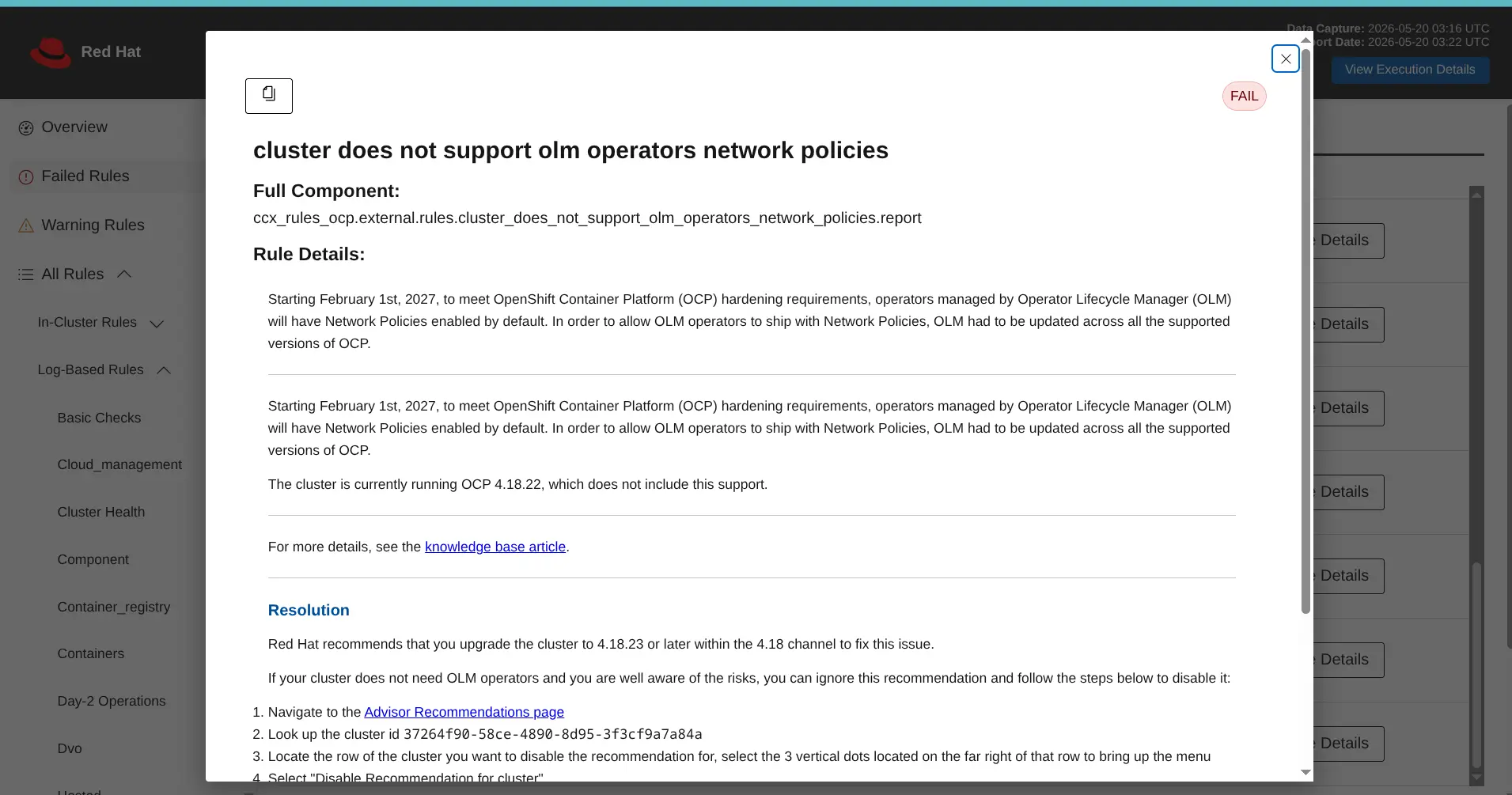
Red Hat OpenShift has long established itself as a cornerstone for modern containerized application deployment, extending far beyond traditional cloud boundaries. Across telecommunications networks, government agencies, and major financial institutions, organizations rely on OpenShift to power critical infrastructure in environments that are intentionally air-gapped and disconnected from the public internet. However, maintaining the operational health of these isolated Kubernetes clusters has historically presented a formidable challenge for IT administrators and DevOps teams.
To address this ongoing operational hurdle, Red Hat has introduced "Pen Drive," a streamlined, lightweight diagnostic solution specifically engineered to bring proactive cluster analysis and maintenance capabilities directly to restricted environments. Led by Tomas Dosek, Principal Product Manager for Red Hat Insights, the initiative aims to mitigate the silent accumulation of configuration drift and underlying technical issues that frequently plague isolated clusters over time, thereby significantly reducing the risk of unexpected production incidents during Day-2 operations.
The inherent isolation of disconnected or restricted Kubernetes environments makes them exceptionally vulnerable to subtle configuration changes and issue buildup. Without regular telemetry and continuous updates flowing back to central management systems, administrative teams often struggle to maintain baseline consistency across distributed hardware and software stacks. Pen drive is designed to bridge this operational gap by acting as a portable, self-contained diagnostic toolbox. Delivered as a single Podman image, the tool requires minimal overhead while packing a robust suite of analytics powered by Red Hat Lightspeed advisor.

Inside its compact framework, which measures just a few hundred megabytes, pen drive packs over 1,000 proactive recommendations focused on debugging cluster architecture, performance optimization, scalability, and routine maintenance. Furthermore, the tool incorporates sophisticated Cluster Compare capabilities derived from Red Hat OpenShift, enabling teams to perform blueprint-based drift analysis and leverage partner-recommended configurations even in environments completely cut off from external networks. For live, production-sensitive environments, a lightweight direct state validation mode ensures that analytics can be performed safely without disrupting ongoing workloads.
In-Cluster Check Capabilities
To accommodate varying operational constraints and resource availability, pen drive offers multiple execution modes, beginning with the in-cluster check capability. Representing the least resource-intensive option in the tool’s repertoire, this mode executes a highly targeted set of commands designed to generate a rapid yet comprehensive baseline health analysis of the cluster.
Originally co-developed alongside strategic partner Nokia to address the unique demands of large-scale telecommunication clusters, this low-footprint diagnostic approach quickly proved its value across a diverse array of enterprise sectors. The in-cluster check inspects several critical operational domains, verifying hardware and firmware inventories, ensuring hostgroup consistency, and evaluating overall cluster health against established operational baselines.

The underlying intelligence driving these checks is far from static. Red Hat and partner field teams actively contribute to the expanding library of recommendations through a collaborative knowledge model. This cooperative approach ensures that the diagnostic rules embedded within pen drive reflect real-world scenarios, emerging edge-computing challenges, and hard-earned lessons from enterprise deployments across the globe.
Kube-Compare Capabilities
Beyond immediate health and inventory checks, maintaining long-term stability in enterprise Kubernetes deployments requires strict adherence to architectural standards. Configuration drift—where individual clusters gradually diverge from their intended baseline configuration over time—remains a primary catalyst for complex production failures.
To combat this phenomenon, pen drive integrates robust kube-compare capabilities. This function performs systematic cluster drift analysis by evaluating actual, real-time cluster configurations against a pre-existing cluster blueprint. These blueprints can be supplied directly by Red Hat or established by partners through the Red Hat Design System blueprint framework. By highlighting discrepancies between the desired state and the operational reality, administrators can swiftly realign their infrastructure before minor inconsistencies escalate into critical system failures.

Full Run Capabilities
When deep investigative work is required to resolve persistent or complex performance bottlenecks, administrators can turn to pen drive’s full run capabilities. This comprehensive diagnostic option collects and analyzes an optimized must-gather archive, conducting a microscopic inspection of the cluster’s vital metrics, configurations, logs, and auxiliary resources spanning the preceding 24 hours.
By processing this rich repository of operational data, the full run option provides the most exhaustive perspective on the cluster’s overall state and historical drift. Crucially, the analysis does not stop at data collection; it delivers actionable, proactive recommendations designed to guide engineers toward precise problem resolution, streamlining the debugging process in environments where troubleshooting resources are often limited.
How Does It Work?
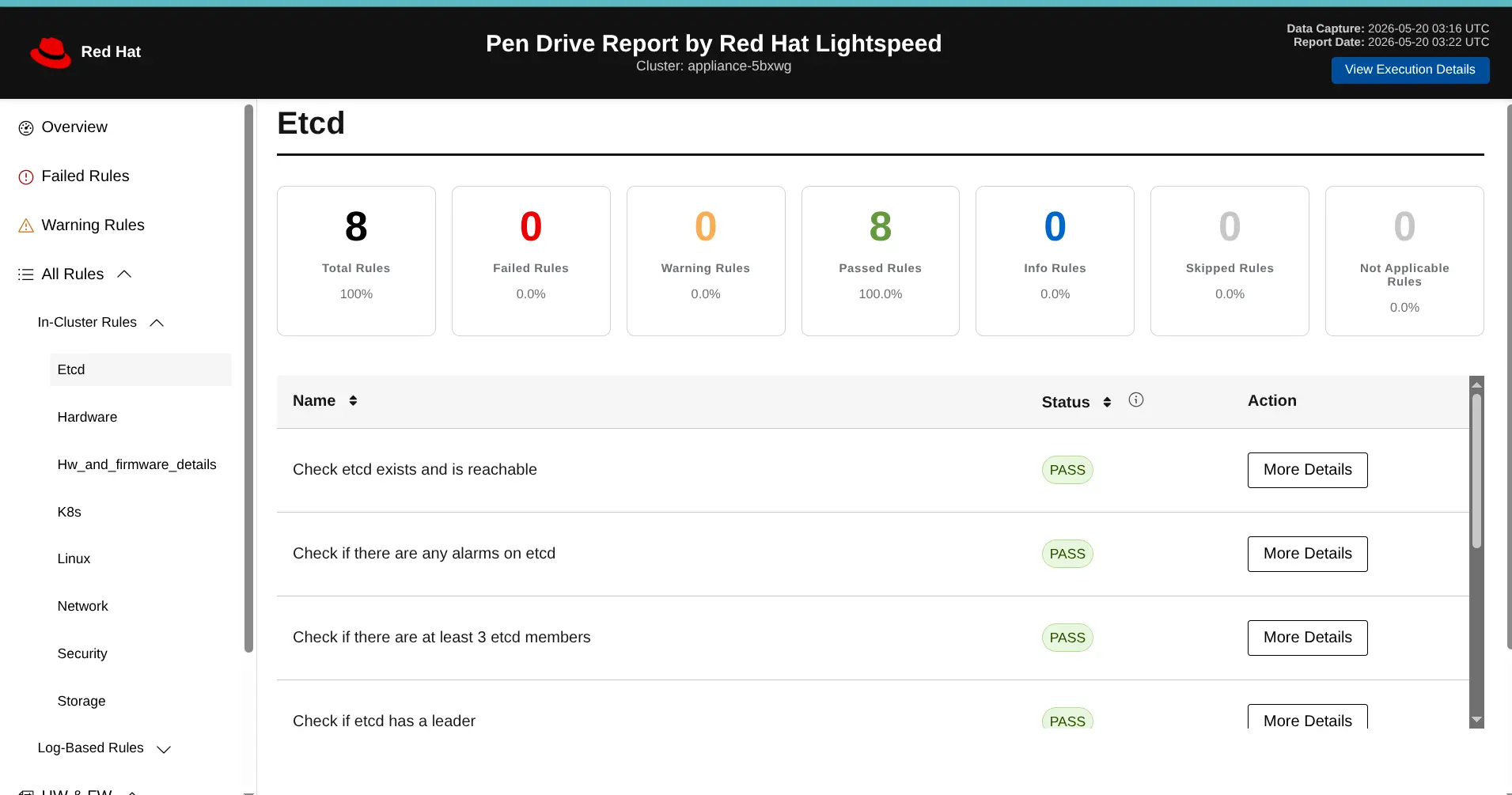
The operational flexibility of pen drive stems from its architecture as a single Podman image. The tool is engineered to execute from virtually any location that maintains network connectivity with the target cluster. Administrators can easily download the container image directly from the Red Hat Ecosystem Catalog and deploy it across a variety of mediums, including a standard USB drive, a portable laptop, a designated jump host, a Red Hat Advanced Cluster Manager Hub cluster, or even directly within the cluster itself.
Once deployed, the utility supports both interactive and non-interactive command execution, adapting seamlessly to different administrative workflows and automation pipelines. The diagnostic engine processes the gathered data and generates dual outputs: a structured JSON file well-suited for machine parsing and integration into broader workflow management automation tools, alongside a standalone, user-friendly HTML report designed for human readability. This HTML report clearly highlights key diagnostic findings and pairs them with specific, contextual recommendations.
Sized at a fraction of traditional diagnostic packages, pen drive delivers enterprise-grade analytical power in a remarkably compact footprint. Because it operates entirely offline, the tool offers a vital resource for DevOps engineers and system administrators tasked with managing Red Hat OpenShift across highly secure, restricted, and air-gapped landscapes. Powered by Red Hat Lightspeed and available at no additional cost to all current Red Hat OpenShift subscribers, the pen drive image is currently available for download through the Red Hat Ecosystem Catalog.












No comments yet. Be the first to join the conversation!