

Transforming a conceptual simulation idea into a fully functional, production-ready application has traditionally required a massive investment of engineering time. Developers must meticulously assemble 3D assets, connect complex physics engines with high-fidelity rendering pipelines, and rigorously test whether a scene behaves according to real-world expectations. Today, however, engineering teams are dramatically accelerating this workflow by pairing frontier artificial intelligence models with NVIDIA Omniverse libraries. This powerful combination allows developers to build sophisticated applications capable of exploring intricate scenarios, investigating mechanical and behavioral failures, and rapidly iterating on design improvements through natural-language instructions.
The underlying mechanics of this workflow rely on direct human-AI collaboration. Developers direct advanced AI agents using plain language to orchestrate the creation process, reviewing the generated outcomes and guiding subsequent changes in real time. Meanwhile, the underlying Omniverse libraries supply heavy-duty technical capabilities, including GPU-accelerated physics, advanced real-time ray-traced rendering, and comprehensive sensor simulation tools. By bridging the gap between high-level conceptual prompts and low-level code generation, this approach is redefining how simulation environments are conceived and deployed across industries ranging from robotics to autonomous transportation and aerospace engineering.
Build a Humanoid Simulator for a Warehouse Environment
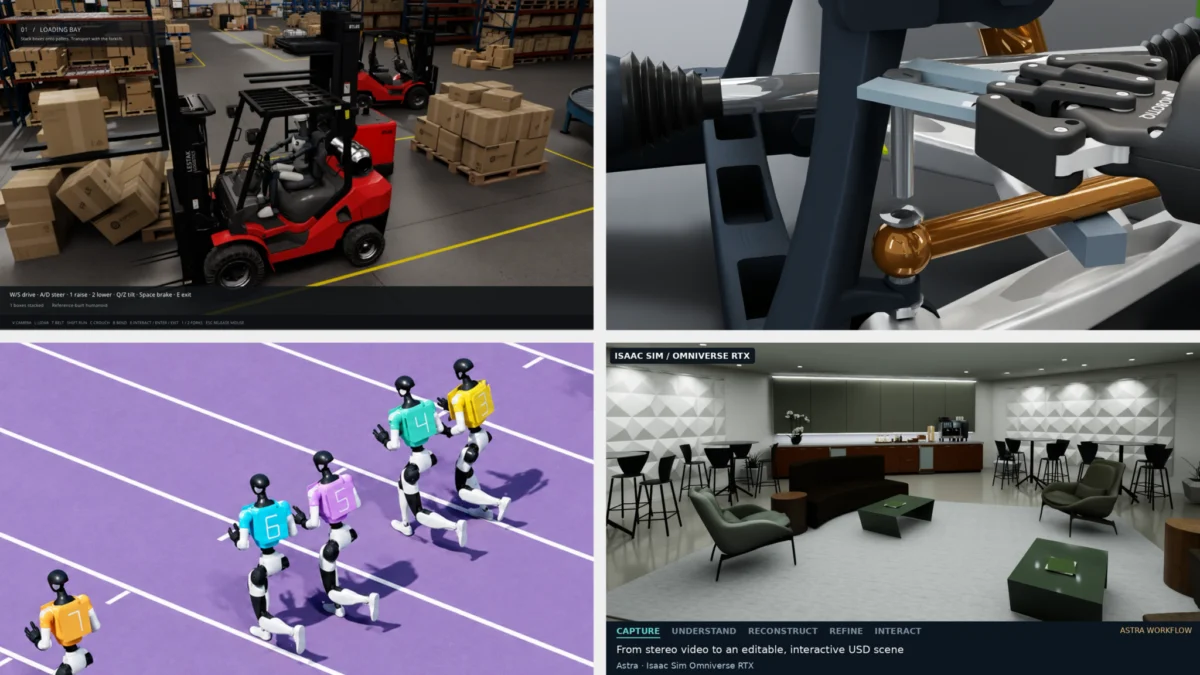
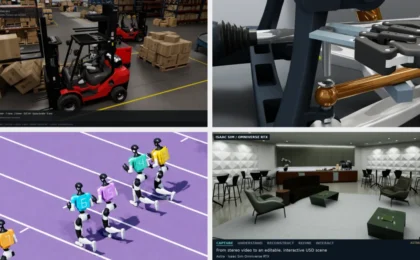
Before organizations can successfully automate complex warehouse tasks, developers require interactive, physics-based simulation environments to thoroughly explore task behaviors and evaluate how physical work gets done. Frank DeLise, an Omniverse product manager at NVIDIA, recently leveraged the GPT-6 Astra model to seamlessly transform a pre-existing SimReady warehouse environment and a humanoid robot model into a fully interactive simulator equipped with both first- and third-person viewing modes.
In this project, DeLise directed the AI agent to interconnect several specialized NVIDIA Omniverse libraries. These included components for GPU-accelerated physics through ovphysx, dynamic scene updates via ovstage, advanced rendering powered by ovrtx, and user interface development utilizing ovui. By combining these libraries with the simready-foundation framework, the system rapidly established the foundational physical scene within the simulation. The AI agent then automatically generated the necessary animation and application code to bind these disparate capabilities into a cohesive, gamified control environment where users can evaluate humanoid robot locomotion and task execution.
Connect an Autonomous-Driving Testing Workflow
Developing and refining autonomous vehicles is an inherently iterative process where modifying a single scene element, adjusting a sensor configuration, or updating a driving model can dramatically alter downstream simulation results. To address the complexities of this workflow, Doyub Kim, a manager on the simulation technology team at NVIDIA, tasked the Astra agent with building "Zero to Alpamayo"—a reusable, highly detailed simulation environment meticulously modeled after San Francisco’s iconic Market Street.
Kim guided the AI agent to map out the entire testing workflow step-by-step, progressively connecting asset creation pipelines, realistic traffic patterns, Omniverse RTX sensor simulation capabilities, and Alpamayo driving models while validating each integration phase. The resulting prototype serves as a robust testing ground for automotive engineers, enabling them to directly compare different driving models and meticulously trace how minor adjustments to a scene or a sensor profile impact actual driving behavior. In a complementary experiment utilizing Cosmos3-Nano, researchers varied weather and lighting conditions within recorded simulation video feeds, allowing Kim to rigorously evaluate how the driving model responds to identical real-world scenarios under vastly different environmental conditions.
Use Sensor Differences to Create and Improve Digital Twins
Ensuring that simulated sensors accurately mirror their real-world counterparts is a critical requirement when developing reliable robots and autonomous vehicles. Ashley Reid, a specialist in RTX sensor validation at NVIDIA, directed Astra alongside Claude Fable 5 agents to directly compare camera feeds and raw LiDAR outputs generated by ovrtx against actual recorded sensor data. Through this iterative validation process, the AI agents successfully created two digital twins entirely from scratch while substantially improving two existing ones.
Over a period of approximately three days, Reid guided an interactive workflow where the AI agents actively measured discrepancies between the simulated outputs and real-world recordings, dynamically generated or modified OpenUSD scenes, and verified the results against strict performance metrics. The modifications automatically addressed missing physical objects, underlying geometry issues, and material discrepancies, with final acceptance hinged strictly on quantifiable camera and LiDAR metrics. This methodology provides developers with a structured, data-driven framework to leverage measured real-world discrepancies for continuous scene refinement and digital twin enhancement.
Robo Olympics: Test Robot Skills With Simulation
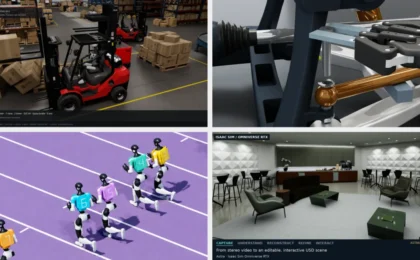
Teaching advanced robots new, dynamic movements requires rigorous validation to ensure that those physical actions remain stable and effective under strict real-world constraints. Tae Kim, who leads NVIDIA Omniverse engineering and product, utilized reference sports videos alongside natural-language instructions to guide the Astra agent in constructing "Robo Olympics"—an experimental project designed to test simulated Unitree G1 humanoid robots performing a variety of complex athletic movements.
Under Kim’s direct supervision, the AI agent built specialized robotic controllers and continuously refined them through cycles of physics trials. The system relied on the Newton Physics Engine to simulate realistic physical behaviors, the open-source NVIDIA Warp framework to accelerate complex mathematical calculations, and ovrtx to render the surrounding scenes and virtual camera images. In one notable trial sequence, the humanoid robot successfully cleared a single hurdle in 64 out of 100 simulation runs. These high-volume trials provided Kim with invaluable performance feedback, offering actionable insights for tuning the robot’s timing, balance, and overall motor control policies.
Test Robotic Disassembly With Computer-Aided Design and Simulation
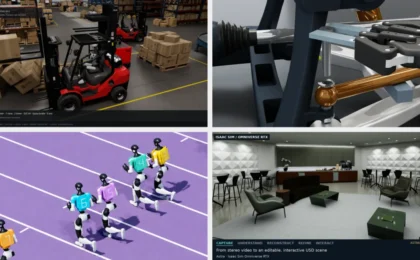
Before a robotic system can safely and efficiently disassemble a manufactured product, engineering teams must verify whether the robot’s physical tools can successfully reach, engage, and remove target components. Jens Jebens, a senior product manager for OpenUSD at NVIDIA, directed the Astra agent to model a complex car suspension system within PTC Onshape and configure it directly inside NVIDIA Isaac Sim.
By leveraging the AI agent, Jebens was able to rapidly explore computer-aided design and tooling revisions informed entirely by physics simulation. The agent accurately measured the available physical clearance and designed a custom wrench tailored specifically for the robot to successfully access and loosen the suspension’s retaining bolts. Jebens subsequently reported the successful simulation-based removal of the suspension component. This workflow successfully bridges the traditional gap between product design decisions, specialized tooling choices, and robotic disassembly outcomes, establishing a solid foundation for subsequent robot policy training.
Bring the International Space Station Into the Browser
Translating complex 3D engineering models into an accessible, interactive application requires seamlessly connecting static assets, live operational data, and a responsive user interface. Nic Johns, an engineering director at NVIDIA, prompted the Astra agent to assemble authentic NASA assets into a comprehensive OpenUSD model of the International Space Station complete with live telemetry feeds. Johns constructed the entire application using a single initial prompt, then utilized a simple follow-up instruction to rotate the orbital scene toward the daytime side of Earth so that the planet was clearly visible in the background.
The underlying technical workflow integrated Blender for initial asset preparation alongside a suite of Omniverse libraries dedicated to real-time rendering via ovrtx, scene runtime management through ovstage, and efficient data streaming via ovstream. The resulting application brings intricate 3D models and live operational telemetry directly into a standard web browser, demonstrating how directors can guide sophisticated software development purely through conversational prompts and targeted corrections.
Turn Captured Rooms Into Testing Environments
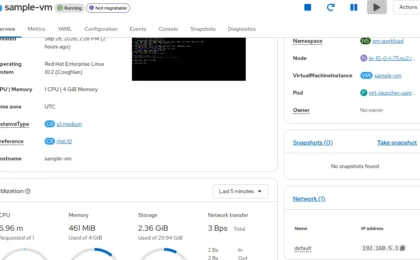
Digitally reconstructed physical rooms require fully editable internal objects and accurate physical behaviors before developers can reliably test human-robot interactions within them. Chirag Majithia, a member of the Isaac engineering applications team at NVIDIA, directed the Astra agent to convert raw stereo camera captures into a fully editable OpenUSD studio environment.
The reconstruction pipeline combined PyCuSFM, FoundationStereo, and nvblox to process the captured spatial data, while human review guided the precise selection and placement of objects. The Astra agent then assembled both procedurally generated and Blender-authored assets, utilizing USD Content Agents to configure how individual items move, collide, and interact within the simulation. Subsequent tests conducted within Isaac Sim guided necessary collision and contact revisions for doors, drawers, and surrounding furniture. By directly connecting captured real-world geometry to advanced interaction testing, the studio environment makes it significantly easier for engineers to identify spatial gaps and evaluate realistic object behaviors.


No comments yet. Be the first to join the conversation!