

The process of translating a high-level simulation concept into a fully functioning, interactive software application has historically required a monumental engineering effort. Traditionally, developers have had to manually assemble complex 3D assets, painstakingly connect disparate physics engines with advanced rendering pipelines, and execute rigorous validation checks to ensure digital scenes behave with real-world physical accuracy. Today, that paradigm is undergoing a profound shift. NVIDIA engineers and developers across the global ecosystem are increasingly combining frontier artificial intelligence models with NVIDIA Omniverse libraries to streamline and accelerate this intricate workload, building sophisticated applications capable of exploring complex scenarios, investigating mechanical failures, and optimizing physical designs from the ground up.
By directing advanced AI agents through natural-language instructions, developers can now orchestrate entire workflows, review generated outputs on the fly, and guide iterative modifications with unprecedented speed. Beneath these conversational instructions, Omniverse libraries provide the robust foundation necessary for high-performance computing, offering GPU-accelerated physics, cutting-edge real-time rendering, and intricate sensor simulation capabilities. A series of recent projects highlights how frontier AI models—such as GPT-6 Astra—are being deployed across various domains, offering a glimpse into the future of automated simulation development.
Build a Humanoid Simulator for a Warehouse Environment
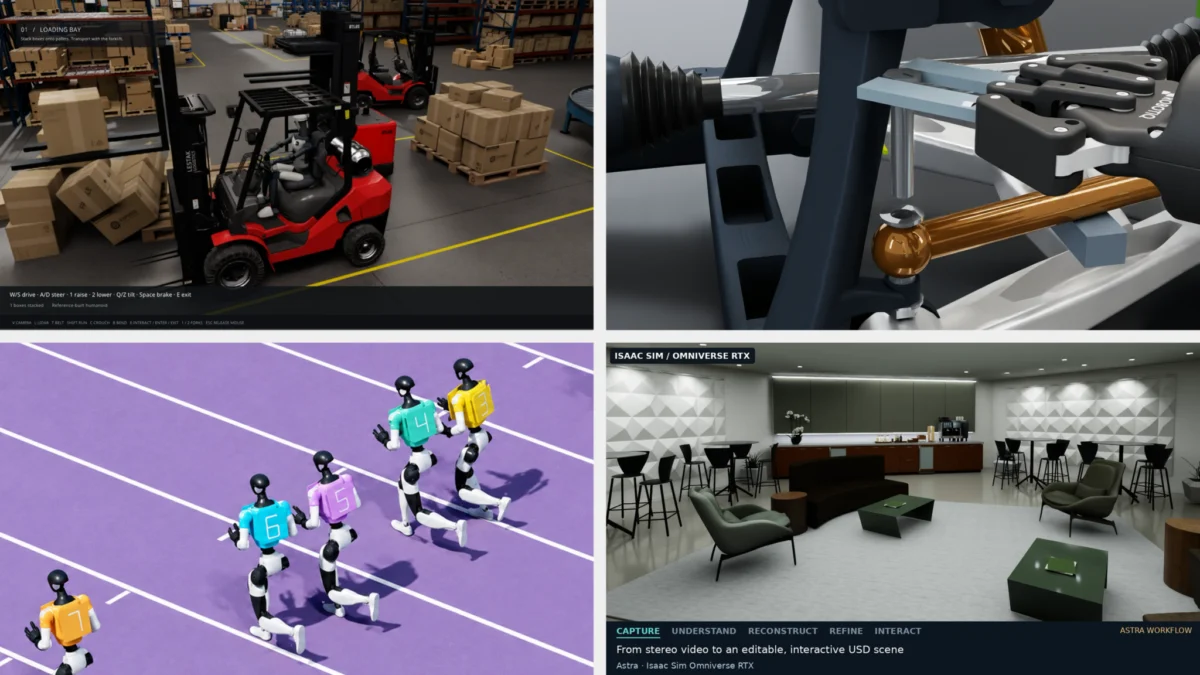
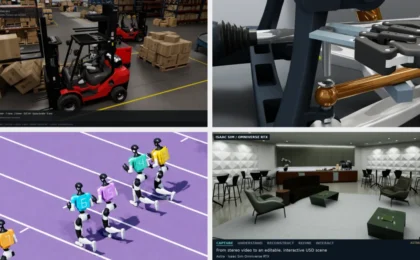
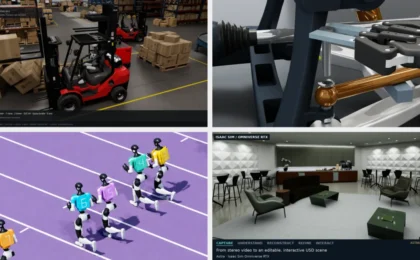
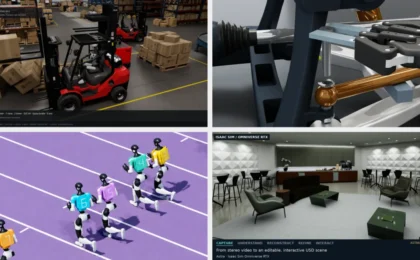
Before organizations can safely deploy automation and robotics into fast-paced commercial spaces, developers require deeply interactive simulation environments to study task behaviors and evaluate operational workflows. Frank DeLise, an Omniverse product manager at NVIDIA, recently addressed this challenge by utilizing the Astra AI model to transform a SimReady warehouse and a humanoid robot into a fully functional, gamified simulator complete with immersive first- and third-person viewing angles.
To achieve this, DeLise directed Astra to seamlessly connect a suite of NVIDIA Omniverse libraries, including ovphysx for advanced physics calculations, ovstage for dynamic scene updates, ovrtx for hyper-realistic rendering, and ovui for user interface management. By combining these libraries with foundational SimReady assets, Astra was able to construct the physical scene entirely within simulation before generating the underlying animation and application code required to bind all the capabilities together. This integrated approach dramatically lowers the barrier to entry for developing complex robotics testing grounds, allowing teams to evaluate humanoid interactions in richly detailed virtual warehouses before deploying hardware into the physical world.
Connect an Autonomous-Driving Testing Workflow
In the realm of autonomous vehicles, even minor modifications to a virtual scene, an onboard sensor suite, or a core driving model can trigger cascading effects throughout a simulation, profoundly altering vehicle behavior. Addressing this sensitivity, Doyub Kim, a simulation technology team manager at NVIDIA, tasked Astra with building "Zero to Alpamayo"—a reusable, highly detailed simulation environment modeled directly after San Francisco’s bustling Market Street.
Kim guided Astra through a phased approach, directing the model to map out the overarching workflow and then sequentially connect asset creation, complex traffic patterns, Omniverse RTX sensor simulation, and Alpamayo driving models while validating each integration step. The resulting prototype serves as a powerful testing ground, enabling engineers to rigorously compare different driving models and meticulously trace how downstream driving behavior responds to subtle changes in the environment or sensor configuration. Complementary experiments using Cosmos3-Nano further allowed Kim to dynamically vary weather conditions and lighting within recorded simulation videos, providing a granular method for comparing how autonomous driving models react to identical scenarios under vastly different environmental pressures.
Use Sensor Differences to Create and Improve Digital Twins
Ensuring that virtual environments accurately mirror reality is critical when testing advanced robots and autonomous vehicles. Engineers must constantly measure how closely simulated sensors correspond to their real-world counterparts. Addressing this validation challenge, Ashley Reid, an RTX sensor validation specialist at NVIDIA, directed Astra and Claude Fable 5 agents to rigorously compare ovrtx camera and raw LiDAR outputs against authentic recorded data, successfully creating two digital twins from scratch while substantially improving two existing models.
Over the course of roughly three days, Reid steered an iterative workflow in which intelligent agents continuously measured discrepancies, generated or modified OpenUSD scenes, and verified the resulting improvements. The adjustments systematically targeted missing objects, complex geometry, and material properties, with acceptance contingent upon strict camera and LiDAR performance metrics. This methodology establishes a reliable framework for developers, demonstrating how measured real-world discrepancies can directly inform and guide the automated creation and refinement of digital twins.
Robo Olympics: Test Robot Skills With Simulation
Teaching autonomous bipedal robots new movements and athletic maneuvers requires rigorous validation to ensure those actions remain stable under strict physical and gravitational constraints. Tae Kim, who leads NVIDIA Omniverse engineering and product, turned to sports videos and natural-language prompts to guide Astra in building "Robo Olympics," an experimental project designed to test simulated Unitree G1 humanoids executing complex sports movements.
Under Kim’s direct supervision, Astra constructed specialized controllers and refined them through countless automated physics trials. The system leveraged the Newton Physics Engine to simulate realistic physical behavior, while the open-source NVIDIA Warp framework accelerated complex calculations, and ovrtx handled the rendering of scenes and virtual-camera perspectives. In one notable sporting trial, the humanoid robot successfully cleared a single hurdle in 64 out of 100 simulation runs. These high-volume trials provided Kim with invaluable performance data and feedback, offering a clear pathway for refining the robot’s timing, balance, and motor control algorithms.
Test Robotic Disassembly With Computer-Aided Design and Simulation
Before an automated robotic system can be safely deployed to disassemble complex manufactured products, developers need absolute certainty that the robot’s mechanical tools can physically reach, grasp, and remove individual internal components. Jens Jebens, a senior product manager for OpenUSD at NVIDIA, tackled this engineering puzzle by directing Astra to model an intricate car suspension system originally designed in PTC Onshape and configure it within NVIDIA Isaac Sim.
Working alongside Astra, Jebens explored advanced computer-aided design and tooling revisions tailored specifically for robotic intervention, driven entirely by simulation insights. The AI agent measured available spatial constraints and dynamically designed a specialized wrench optimized for the robot to reach and loosen the suspension’s tightly packed bolts. Jebens ultimately reported the successful virtual removal of a suspension component, demonstrating how tightly coupling computer-aided design and tooling decisions with real-time simulation outcomes can establish a robust foundation for downstream robotic policy training.
Bring the International Space Station Into the Browser
Converting static 3D models into fully interactive, data-connected web applications typically demands deep expertise in graphics pipelines and user interface design. Nic Johns, an engineering director at NVIDIA, bypassed traditional hurdles by prompting Astra to assemble authentic NASA assets into a comprehensive OpenUSD model of the International Space Station infused with live telemetry data. Johns successfully constructed the entire application using a single initial prompt, subsequently utilizing a follow-up instruction to dynamically shift the orbital scene toward Earth’s daytime side so that the planet became vividly visible from orbit.
The underlying technical workflow relied on Blender for initial asset preparation alongside a robust stack of Omniverse libraries, including ovrtx for real-time rendering, ovstage for scene runtime management, and ovstream for efficient video streaming. By bridging 3D assets and live operational telemetry directly into a standard web browser through natural-language prompts and iterative corrections, the project illustrates how complex visualization applications can be rapidly prototyped and deployed.
Turn Captured Rooms Into Testing Environments
Digitally reconstructing a physical room for robotics testing requires more than just capturing visual geometry; the resulting environment must feature fully editable objects and accurate physical behaviors before developers can reliably test physical interactions. Chirag Majithia, a member of the Isaac engineering applications team at NVIDIA, directed Astra to convert raw stereo camera captures into a fully editable OpenUSD virtual studio.
The reconstruction workflow integrated PyCuSFM, FoundationStereo, and nvblox to process the spatial data, relying on careful human review to guide object selection and placement. Astra subsequently assembled a combination of newly generated and Blender-authored assets, employing specialized USD Content Agents to configure how individual items move, collide, and interact within the simulation. Subsequent Isaac Sim testing guided necessary collision and contact revisions for doors, drawers, and surrounding furniture. By seamlessly connecting captured physical geometry directly to rigorous interaction testing, the approach makes identifying environmental gaps and tuning object behaviors significantly more straightforward for development teams across the industry.





No comments yet. Be the first to join the conversation!