

The first precision commercial alternative to the Global Positioning System (GPS) is preparing to go live this month, as startup Xona Space Systems sends six new satellites into low-Earth orbit aboard a SpaceX rocket.
For decades, global navigation and timing services have remained strictly within the domain of government-backed monopolies. Traditional satellite networks operated by the United States, Europe, China, and Russia have provided foundational utility across the globe, yet their free signals come with inherent vulnerabilities. They are notoriously easy to jam, highly susceptible to spoofing, and fundamentally lack the extreme precision required for advanced, highly automated applications such as autonomous vehicles and precision farming robots.
Challenging a ubiquitous, taxpayer-funded utility that is provided free of charge might appear counterintuitive or even foolhardy at first glance. However, Xona is positioning itself to disrupt satellite-based navigation and timing in much the same way other venture-backed startups have transformed traditional aerospace and infrastructure sectors.
The company’s roots stretch back to 2019, when a group of five engineering graduates from Stanford University’s aerospace program began exploring the limitations of existing infrastructure. Among them was Tyler Reid, who later earned a doctoral degree focusing his thesis on the potential for utilizing low-Earth orbit satellites to dramatically enhance navigation capabilities. During informal brainstorming sessions fueled by pizza and beer, the friends debated whether solving the critical performance gaps of legacy networks could form the foundation of a viable commercial business.
Reflecting on the initial concept during a visit to the company’s headquarters, Xona CEO Brian Manning recalled his immediate skepticism. His knee-jerk reaction was that the idea seemed fundamentally flawed, questioning why anyone would ever attempt to replace a service like GPS when it is completely free to use.
However, as Manning delved deeper into the economics of the industry, his perspective shifted entirely. He recognized that while people commonly think of GPS as a free service, the actual market is defined by hardware rather than the broadcast signal itself. With billions of consumer and industrial devices sold every year that rely on location data, those components are certainly not given away for free. This revealed an immense, underserved global market that is desperately searching for vastly superior performance, reliability, and precision.
Despite identifying a clear market demand, the path toward delivering such an ambitious commercial service presented formidable technical hurdles. Enhancing standard GPS signals with a much stronger transmission that delivers vastly more precise timing and spatial coordinates required entirely new engineering solutions.
Traditional navigation satellites rely on massive, highly expensive onboard atomic clocks to maintain precise time synchronization. To bypass this costly constraint, Xona developed a unique architecture that allows its satellites to maintain exact timekeeping without onboard atomic clocks. This innovation takes full advantage of the spacecraft’s close proximity to Earth and its continuous, real-time communication with ground-based sources of truth.

Another critical engineering challenge solved by the team was ensuring that Xona’s advanced signals could be received effortlessly by existing commercial GPS receivers. By designing a system that requires only a relatively simple software modification rather than entirely new hardware infrastructure, the startup secured immediate access to a massive existing market while significantly smoothing the regulatory pathway required for broadcasting commercial navigation signals.
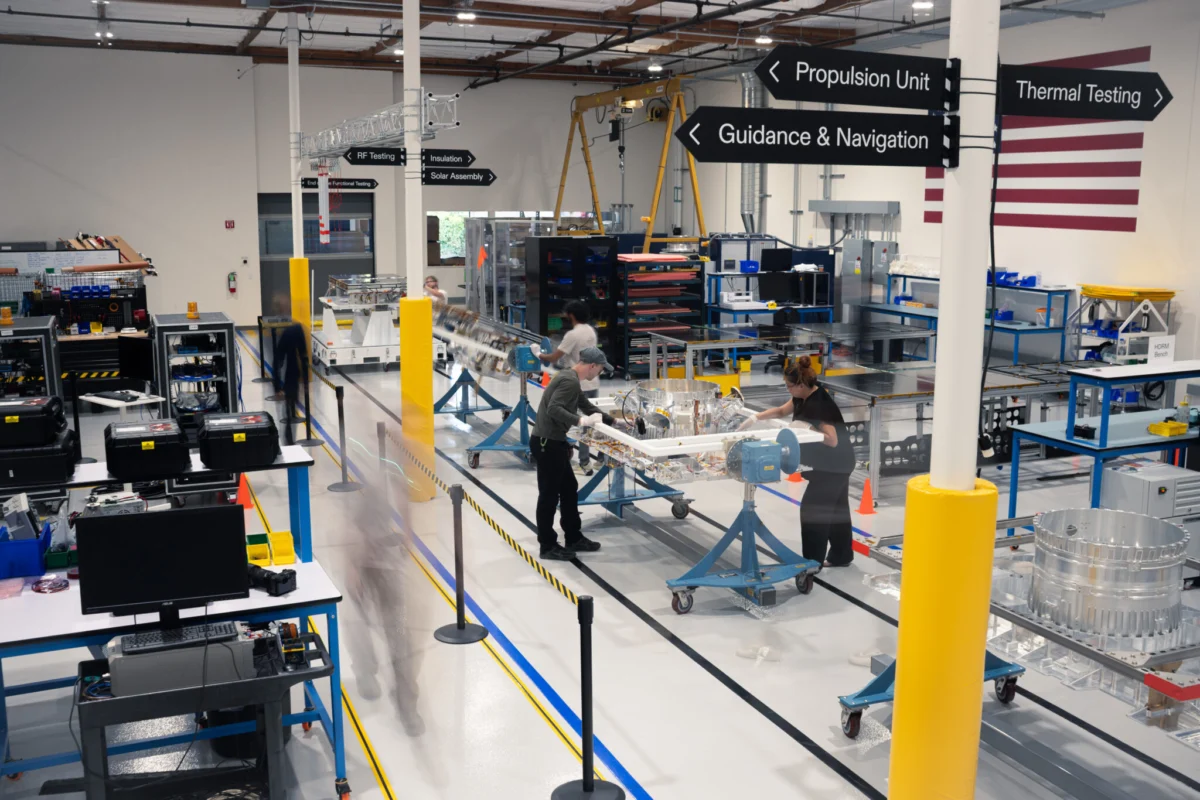
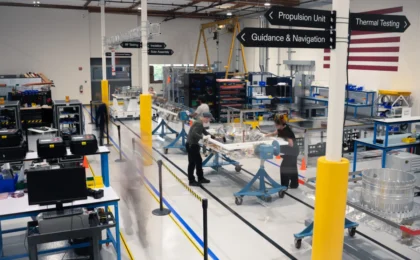
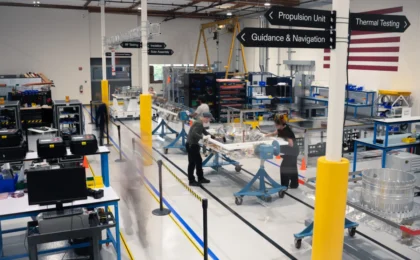
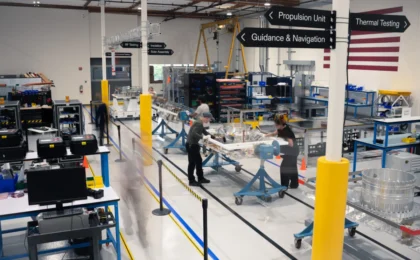
The upcoming SpaceX launch marks a major milestone for these efforts. Six satellites are scheduled to lift off later this month, representing a vital step toward the deployment of Xona’s full operational constellation, known as Pulsar. Four of the spacecraft are similar to a successful prototype launched by the company last year, which thoroughly validated its core technology in orbit. Those four satellites are built around an established platform provided by Aerospace Labs. Meanwhile, the remaining two satellites were constructed entirely by Xona at its manufacturing facility in Burlingame, California, serving as the foundational templates for the planned 258-satellite constellation.
Once fully deployed, the Pulsar constellation will offer centimeter-level precision for geolocation, a dramatic improvement over the meter-level accuracy provided by standard GPS networks. Furthermore, the signal strength is engineered to be powerful enough to penetrate deep inside buildings and dense urban environments where traditional satellite signals frequently fail or degrade. Manning also believes that the heightened signal power will inherently act as a strong deterrent against potential jammers and spoofers.
Immediate testing will commence soon after launch. Xona will begin beta-testing the Pulsar network with real-world commercial customers once the spacecraft reach orbit and begin passing overhead across the mid-latitudes approximately eight times a day.
Early commercial partners are already lining up to test the service. Ian Gough, the CEO of TimeBeat—a firm specializing in electronic timing systems—notes that this initial pilot phase will enable his engineering team to rigorously check, verify, and correct the timing data supplied by their devices deployed around the world. Looking further ahead, Xona targets full commercial coverage across the United States, Europe, Japan, and South Korea by the year 2028.
To date, Xona has raised slightly over $300 million in funding from venture capital investors since its inception. This total includes a notable $20 million investment from the U.S. Space Force. While the company remains firmly dedicated to building a robust commercial enterprise, the active interest from the U.S. government underscores the critical national security implications of the technology, particularly as electronic jamming and signal spoofing become increasingly prevalent in modern geopolitical conflicts.
Beyond enterprise timing and logistics, Xona is positioning its technology to meet the demands of an increasingly autonomous future. Tyler Reid, whose doctoral research originally inspired the company and who now serves as its Chief Technology Officer, previously worked on self-driving car development at Ford Motor Company. During that time, he realized firsthand that consumer-grade and industrial autonomous vehicles would ultimately require a vastly superior navigation service like Pulsar to safely unlock their full potential.
Xona’s headquarters offers a sweeping view of commercial aircraft descending toward the runways of San Francisco International Airport. Watching the jets touch down smoothly, Manning draws a direct parallel between the aviation sector and the future of terrestrial autonomy. He points out that among all forms of mass transportation, the ultimate gold standard for safety is civil aviation, and expresses confidence that the infrastructure Xona is building will play a major role in bringing that same level of absolute reliability to self-driving cars, allowing passengers to eventually feel just as secure taking their hands off the steering wheel as they do relaxing inside a commercial airliner.









No comments yet. Be the first to join the conversation!