

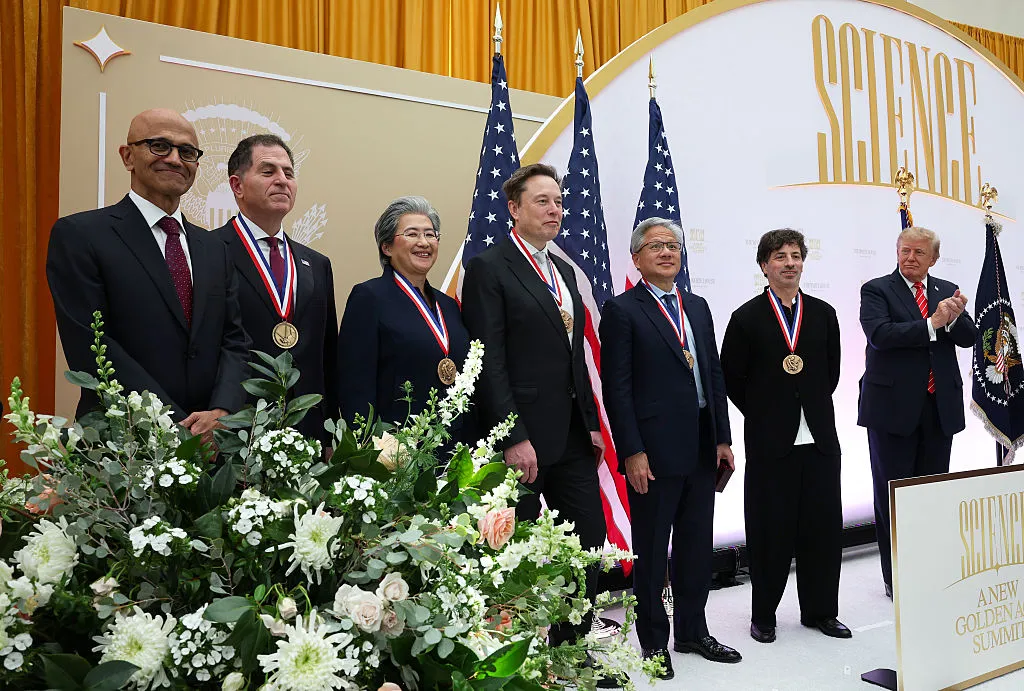
President Trump bestowed the nation’s highest science and technology honors upon some of the most prominent figures in the global technology industry during a high-profile ceremony held on Thursday. The recognitions took place at the White House during the Golden Age of American Innovation Summit, an event designed to celebrate technological leadership, engineering achievements, and economic contributions from the private sector.
Among the recipients of the National Medal of Science—widely recognized as the country’s premier science prize—were Tesla and SpaceX leader Elon Musk, Nvidia Chief Executive Officer Jensen Huang, Alphabet co-founder Sergey Brin, and AMD Chief Executive Officer Lisa Su. In addition to these awards, the National Medal of Technology and Innovation was presented to Dell Technologies founder and CEO Michael Dell, as well as Microsoft CEO Satya Nadella, cementing a major intersection between Silicon Valley leadership and federal recognition.
During the ceremony, President Trump praised the honorees for their collective impact on the nation’s technological trajectory. Addressing the gathered executives and policymakers, the president stated that the awardees had helped "pioneer an incredible future for America." He further emphasized that because of their groundbreaking work and ongoing dedication to technological advancement, "we will always be on top. No one else can compete with us."
Substantial Financial Contributions and Philanthropic Ties
The awarding of the nation’s highest civilian technological honors has drawn considerable public attention and scrutiny regarding the financial connections between the recipients, their respective corporations, and the broader political landscape. According to reports compiled and analyzed by The New Republic, the honorees and their corporate entities have collectively donated nearly $6 billion to various efforts, political action committees, and initiatives tied directly to President Trump and his administration.
The nature of these contributions spans a wide array of political and philanthropic commitments. For instance, major technology conglomerates such as Alphabet and Microsoft previously directed funds toward the president’s official inauguration fund, as well as the modernization and construction efforts associated with the White House ballroom. Meanwhile, semiconductor manufacturer AMD provided financial backing to a prominent pro-Trump Super PAC, aligning corporate political contributions with the administration’s broader policy goals.

Beyond direct political donations, individual contributions from the honorees have also taken the form of major philanthropic pledges. Notably, Michael Dell and his wife, Susan Dell, pledged a monumental $6.25 billion to help fund the Trump Accounts, a federal savings and asset-building program specifically aimed at children. This contribution represents one of the largest philanthropic commitments linked to an administration-backed initiative in recent memory, drawing both praise for its scale and debate over the intersection of private wealth and public policy.
Parallel Policy Developments and Regulatory Complexities
The timing of the White House honors has also highlighted complex policy developments unfolding concurrently between the federal government and the technology sector. The juxtaposition of high-level government recognition and restrictive regulatory actions was particularly evident in the case of Microsoft and its leadership.
Satya Nadella accepted the National Medal of Technology and Innovation under unique circumstances, arriving at the summit shortly after the administration announced an indefinite suspension of Microsoft from the H-1B visa program. The H-1B program has long served as a critical pipeline for U.S. technology companies, enabling them to recruit and hire highly skilled foreign workers across engineering, software development, and specialized scientific disciplines.
The suspension of a major tech giant from the visa program just as its chief executive is being honored with the nation’s top technological distinction underscores the intricate and sometimes contradictory relationship between the administration and the technology industry. While the White House continues to celebrate corporate leaders for driving American economic dominance and artificial intelligence innovation, it simultaneously pursues stringent domestic labor and immigration policies that directly impact how these same companies operate on a day-to-day basis.
As the technology sector navigates shifting regulatory frameworks, global supply chain pressures, and evolving national security priorities, events like the Golden Age of American Innovation Summit serve as a public barometer of the complex dynamics connecting political powerhouses in Washington with the corporate titans shaping the future of global technology.







No comments yet. Be the first to join the conversation!