

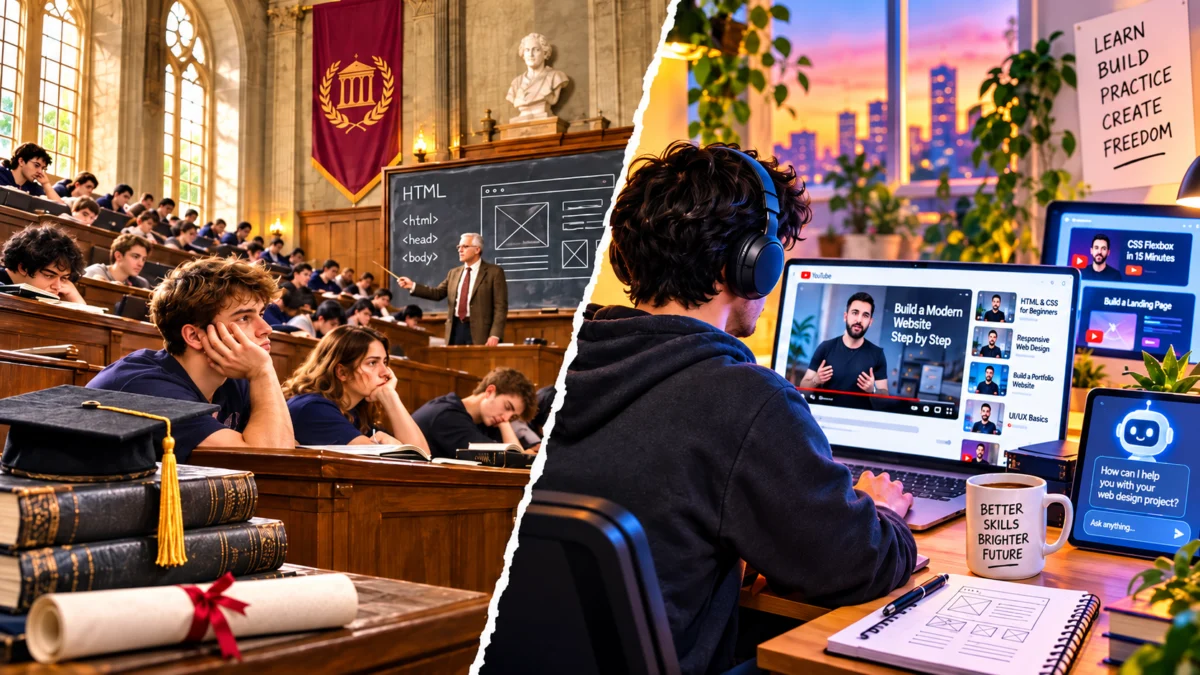
Fifteen years ago, aspiring to become a web designer or digital developer meant committing to a traditional educational path. Breaking into the industry required enrolling in an academic institution where instructors could systematically introduce HTML, CSS, Photoshop, typography, user experience (UX) principles, and the myriad other technical skills that once felt exclusive to the internet’s inner circle.
Today, the modern digital landscape offers an entirely different entry point. Anyone wishing to acquire these same competencies can simply open YouTube.
The shift has been both swift and comprehensive. Individuals eager to learn Figma can choose from thousands of detailed tutorials. Those wanting to master CSS Grid can select from an array of expert teachers, while comprehensive courses on web accessibility are frequently available at no cost. For those moments when a concept remains obscure, generative artificial intelligence tools like ChatGPT and Claude can step in to provide personalized explanations, review raw code, isolate specific mistakes, and clarify precisely where a project went wrong.
This phenomenon has effectively birthed what many in the tech industry now call "YouTube University." The tuition is essentially zero, and the traditional higher education sector is facing a profound institutional challenge as a result.
YouTube University Moves a Much Faster Pace
The core friction lies in a stark contrast of momentum: traditional universities move deliberately and slowly, whereas the digital web changes overnight.
Developing, reviewing, and approving a standard university course can take months or even years of bureaucratic oversight. By the time an academic department updates its syllabus to reflect contemporary web standards, the industry has often moved past them. Conversely, when a new design tool or advanced artificial intelligence feature is released, independent creators and software engineers routinely upload comprehensive video tutorials addressing the update before the average student has finished their morning coffee.
Artificial intelligence has only widened this operational gap. While YouTube provides the instructional lesson, modern AI models function as a tireless, near-instant personal tutor. Students can ask follow-up questions, request progressively simpler explanations, paste broken code snippets directly into a prompt, or build an application and immediately ask why it is failing to execute correctly.
Higher education students have already embraced this shift on a massive scale. According to the 2026 HEPI Student Generative AI Survey, an overwhelming 95% of surveyed UK undergraduates reported using artificial intelligence in some capacity for their academic and personal learning. Universities are no longer in a position to decide whether students should incorporate AI into their education; students have already made that decision for themselves.
The Uncomfortable Question: Why Pay for a Degree?
This dynamic gives rise to an increasingly uncomfortable financial and professional question: why pay exorbitant tuition fees when the same knowledge is available for free?
It is entirely possible for one individual to spend four years and tens of thousands of dollars earning a traditional computer science or digital design degree, while another person spends those exact same years studying top-tier designers and developers on YouTube, leveraging AI as an interactive tutor, and actually building functional websites. Eventually, both candidates may find themselves competing for the exact same entry-level position in the job market.
This tension is especially acute within the field of web design and development, where employers evaluate candidates based on tangible proof of skill rather than pedigree alone. According to data from the U.S. Bureau of Labor Statistics, web developers and digital designers frequently do not need specific educational credentials if they can thoroughly demonstrate their technical abilities through a robust portfolio of completed projects and real-world experience.
When a well-crafted portfolio speaks loudly enough to secure employment, the value proposition of a traditional degree becomes murky. Students are left asking a fundamental question: what exactly are they paying for?
YouTube University Has a Problem Too
Despite its accessibility and speed, YouTube University is far from a complete educational ecosystem. While it can teach almost any isolated technical skill imaginable, it is notoriously poor at helping learners determine what they actually should learn.
Self-directed learners frequently fall into familiar internet rabbit holes. A student might start watching a tutorial on CSS Grid, jump abruptly to an advanced artificial intelligence workflow, spend two hours analyzing a creator’s redesign of Spotify, discover a powerful no-code platform like Webflow, and ultimately end up watching sensationalized content promising ten insane free AI tools.
No system forces a self-taught designer to prioritize rigorous accessibility standards when building an interface if they would rather spend their time crafting flashy, complex animations. No automated tool provides the nuanced critique necessary to refine a flawed user flow. As a result, self-taught individuals can become surprisingly capable at executing specific tasks while simultaneously carrying enormous, unaddressed blind spots in their foundational knowledge.
Artificial intelligence shares a similar underlying weakness. An AI model will enthusiastically assist a user in building a fundamentally flawed or poorly structured interface if the user lacks the foundational expertise required to recognize that the output is substandard.
It is precisely within these areas of structural oversight, critical evaluation, and foundational rigor that traditional universities still hold a competitive advantage—provided they are willing to evolve.
Stop Competing with YouTube
There is little strategic sense in charging students thousands of dollars in tuition to sit in a lecture hall absorbing raw information that they could easily consume via a high-quality online video the same evening.
Instead, modern universities should focus on offering the elements that decentralized online platforms cannot replicate: dedicated mentorship, rigorous and constructive critiques, structured peer collaboration, and accountability. Academic institutions should challenge students to robustly defend their design decisions, test live websites on real human users, and master the foundational pillars of accessibility, cognitive psychology, typography, and advanced UX design—covering all the critical, less glamorous subjects that online tutorials make easy to bypass.
At the same time, universities must embrace the reality of artificial intelligence rather than resisting it. Instead of assigning a week of manual coding for a basic, repetitive webpage, educators can task AI with generating the initial framework, directing students to spend the week diagnosing its vulnerabilities, optimizing its performance, making it fully accessible, and transforming it into something genuinely original and useful.
The overarching goal of higher education must shift from teaching students how to produce basic digital assets to teaching them how to think critically.
Universities Are Starting to Get It
Some forward-thinking academic institutions have already begun recognizing this reality and implementing systemic changes.
The University of Victoria has overhauled its computer science curriculum, deliberately integrating artificial intelligence concepts and practices throughout the entirety of its programs rather than relegating the technology to an optional elective course. Similarly, the University of British Columbia has introduced curriculum updates designed to prepare undergraduates for an AI-driven professional future, incorporating modules on how to judiciously select digital tools and critically evaluate the validity of their outputs.
These adjustments represent a move in the correct direction. Rather than fearing the rise of decentralized online learning, progressive universities are beginning to recognize that their survival depends on offering what online video platforms simply cannot match.
The New Competitive Landscape
A modern web design degree is no longer competing merely against other academic programs. It is competing against an entirely new pedagogical model: YouTube, combined with advanced artificial intelligence, backed by several years of hands-on project building. That combination presents a formidable alternative, and the supporting digital infrastructure improves with each passing month.
Even so, traditional institutions retain access to resources that hold genuine value for developing professionals—structured guidance, experienced mentorship, peer critique, collaborative environments, and the deep, contextual knowledge that self-directed learners frequently overlook in their rush to build functional products.
However, students should be paying precisely for those structural and mentorship-driven benefits, rather than funding lectures full of basic technical facts that are freely available online. The future of professional education likely lies neither in traditional university exclusivity nor in unguided self-teaching, but in the deliberate integration of the best elements from both worlds.
Ultimately, if a modern design school or degree program cannot offer an experience demonstrably superior to an independent journey through online tutorials and an AI subscription, students have every right to question the return on their investment.







No comments yet. Be the first to join the conversation!