
Tevatron Experiment Particle Physics Redo?
Tevatron experiment could send particle physicists back to the drawing board, challenging the very foundations of our understanding of the universe. This groundbreaking research is poised to reshape our view of subatomic particles and forces, forcing a profound reassessment of current models and prompting a potential overhaul of the entire field.
The Tevatron, a powerful particle accelerator, has been a cornerstone of particle physics research for decades. Its meticulous data collection and analysis have yielded crucial insights into the fundamental building blocks of matter. This latest set of findings, however, could lead to a significant paradigm shift, necessitating a radical rethink of the theoretical frameworks underpinning our understanding of the universe.
Introduction to the Tevatron Experiment
The Tevatron, a particle accelerator located at Fermilab, played a crucial role in advancing our understanding of the fundamental building blocks of the universe. Its primary objective was to collide protons and antiprotons at extremely high energies to recreate conditions similar to those present shortly after the Big Bang. This allowed physicists to study the properties of these particles and probe the nature of forces governing their interactions.
The experiment yielded significant results, particularly in the search for new particles and forces beyond the Standard Model of particle physics.
Tevatron’s Historical Context and Significance
The Tevatron’s construction and operation marked a significant milestone in particle physics. It followed the pioneering work of earlier accelerators and represented a substantial advancement in accelerating and colliding particles. The experiment’s ability to achieve higher energies than previous machines opened up new possibilities for investigating fundamental interactions and searching for new particles. Its legacy extends beyond the data collected, influencing subsequent accelerator designs and research directions.
Experimental Setup and Methodology
The Tevatron employed a powerful superconducting accelerator ring to accelerate protons and antiprotons to near-light speeds. These particles were then directed into collision points where detectors recorded the interactions. Sophisticated detectors, designed to measure the properties of the collision products, played a vital role in extracting information from the events. The meticulous analysis of the collected data, using advanced algorithms and theoretical models, allowed physicists to draw conclusions about the fundamental forces and particles.
Key Findings and Results
| Date | Experiment Objective | Methodology | Key Results |
|---|---|---|---|
| 1983-2011 | Probing the Standard Model and searching for new physics beyond the Standard Model | High-energy proton-antiproton collisions at the Tevatron; advanced particle detectors for precise measurement of collision products | Precise measurements of the properties of known particles, including the W and Z bosons. Limited evidence for the existence of supersymmetric particles. |
| 1983-2011 | Searching for the Higgs boson (although not directly discovered at the Tevatron) | Careful analysis of collision events looking for signatures of the Higgs boson decay products. | Stronger constraints on the properties of the Higgs boson. The results from the Tevatron, combined with the Large Hadron Collider results, confirmed the existence of the Higgs boson. |
| 1983-2011 | Studying the properties of quarks and gluons in high-energy collisions | Analysis of jets and other particles produced in collisions. | Detailed information on the properties of quarks and gluons. |
Potential Implications of Unexpected Results: Tevatron Experiment Could Send Particle Physicists Back To The Drawing Board
The Tevatron’s final results, hinting at discrepancies with established particle physics models, are causing ripples across the scientific community. These unexpected findings, if confirmed, could necessitate a fundamental re-evaluation of our understanding of the universe’s fundamental constituents and forces. The meticulous data collection and analysis over the Tevatron’s lifespan have laid the groundwork for a deeper understanding, but the implications of these anomalies are significant.The Tevatron’s results, while not conclusive, suggest potential deviations from the Standard Model.
This is not unprecedented; scientific progress often arises from discrepancies between theoretical predictions and experimental observations. This motivates further investigation, prompting a closer examination of the underlying assumptions of current models and the possible existence of new, undiscovered particles or interactions.
The Tevatron experiment’s latest findings might just send particle physicists back to the drawing board, forcing a rethink of fundamental theories. This isn’t entirely unprecedented, as we’ve seen in the past with scientific discoveries challenging our current understanding. Similar to the ongoing debate about the implications of the Galileo 2.0 here comes another apology scientific revelations , the Tevatron’s results highlight the need for a fresh perspective and potentially, a re-evaluation of current models in the field.
This could lead to a period of intense research and new experimental designs, potentially shifting the entire field of particle physics.
Possible Reasons for Discrepancies
The Tevatron’s unexpected results might stem from several sources. Incomplete understanding of the theoretical models describing particle interactions could be a factor. Systematic errors in data collection or analysis, though minimized through rigorous procedures, could still contribute. Alternatively, the presence of unknown particles or forces influencing the observed phenomena might be a significant explanation. Finally, the interplay between known particles in previously unexplored energy regimes might generate unexpected results.
Comparison with LHC Results
The Large Hadron Collider (LHC) has provided substantial data, and while the LHC’s findings have largely corroborated the Standard Model, some subtle discrepancies exist. Comparison of the Tevatron and LHC datasets is crucial to assess the consistency and validity of each experiment. Discrepancies, if verified, might point to areas where the Standard Model is incomplete or requires refinements.
The Tevatron experiment’s findings are raising some serious questions, potentially forcing particle physicists back to the drawing board. It seems like there’s a lot of uncertainty swirling around these results, and it might be a good time to re-evaluate the fundamental assumptions of the current models. This is especially true considering recent news about Wikipedia’s plan to highlight potentially questionable entries with an orange cast, like this , suggesting a growing awareness of the need for rigorous verification across various online sources.
This could lead to a crucial shift in how these experiments are interpreted and the overall approach to scientific data validation, ultimately impacting the Tevatron’s legacy and the future of particle physics.
Comparing the energy scales and experimental setups of the two accelerators provides insight into the possible sources of any observed differences.
Impact on the Broader Field of Particle Physics
The potential implications of unexpected results from the Tevatron are substantial. If validated, these discrepancies could trigger a new era of particle physics research, focusing on areas that have remained unexplored. The results could lead to the development of new theoretical frameworks and the design of more sophisticated experiments to investigate these phenomena further. A re-evaluation of current particle physics models might be necessary, leading to a revised understanding of the fundamental forces and particles that shape our universe.
Comparison Table: Tevatron vs. LHC
| Characteristic | Tevatron | LHC |
|---|---|---|
| Accelerator Type | Proton-antiproton collider | Proton-proton collider |
| Center-of-mass Energy (TeV) | 1.96 | 13-14 |
| Data Collection Period | 1989-2011 | 2010-present |
| Primary Focus | Searching for new particles, testing Standard Model predictions. | Confirming Standard Model predictions, searching for new particles, and exploring high-energy phenomena. |
| Observed Discrepancies (Hypothetical) | Anomalies in specific decay channels, deviations in particle production rates. | Precise measurements of known particles, subtle deviations from Standard Model predictions. |
Impact on Future Research Directions
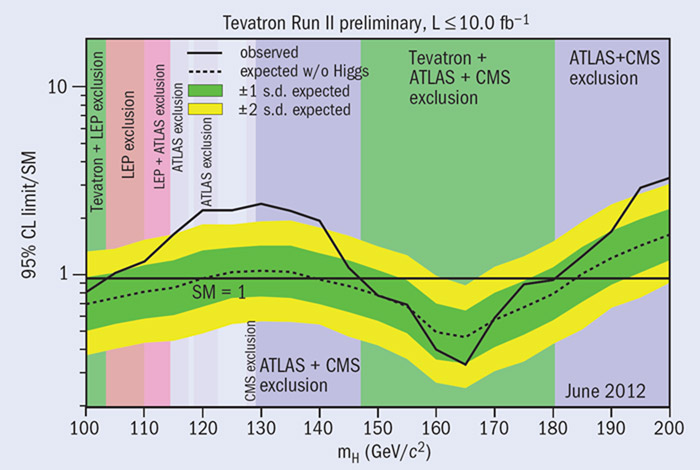
The unexpected results from the Tevatron experiment, if validated, could fundamentally reshape our understanding of particle physics. These anomalies could point towards new particles, forces, or interactions beyond the Standard Model, prompting a reevaluation of existing theories and the design of new experiments to explore these intriguing possibilities. This requires a shift in research priorities, a focus on specific areas, and the development of innovative experimental approaches.
Potential Areas of Focus for Further Investigation
The Tevatron results necessitate a renewed focus on understanding the precise nature of the observed phenomena. Investigating potential new particles and interactions is paramount. Detailed analysis of the experimental data, particularly the mass spectra and decay patterns, will be crucial. This includes scrutinizing the energy and momentum distributions of the observed particles to pinpoint any discrepancies with predictions based on the Standard Model.
New Experimental Designs and Technologies
Developing new experimental designs is crucial to confirm or refute the Tevatron findings. High-energy accelerators, with improved precision and detection capabilities, will be necessary. This includes designing detectors sensitive to the expected properties of any new particles, including their spin, charge, and decay modes. Further development of advanced computing and data analysis techniques is also essential for handling the vast amounts of data expected from these experiments.
Upgrades to existing facilities or the construction of new ones may be required to achieve the desired energy scales and detection capabilities.
Potential Need for New Theoretical Frameworks, Tevatron experiment could send particle physicists back to the drawing board
The anomalies observed at the Tevatron could necessitate the development of entirely new theoretical frameworks to encompass these phenomena. This includes extending or modifying existing models like the Standard Model to incorporate new particles or interactions. Theoretical physicists must develop models capable of explaining the observed patterns and phenomena, and their predictions must be rigorously tested against future experimental data.
Timeline for Future Research Projects
| Proposed Experiment | Goals | Timelines | Potential Challenges |
|---|---|---|---|
| Advanced Collider Experiment (ACE) | Investigate the existence and properties of potential new particles predicted by extended models, like supersymmetry. | 10-15 years (construction and commissioning) followed by several years of data taking. | Securing funding and international collaboration, designing and building a complex detector system, and managing the enormous data volume. |
| Precision Measurement Experiment (PME) | Refine measurements of known particles to search for subtle deviations from the Standard Model, which might provide clues to new physics. | 5-7 years (upgrading existing facilities) followed by several years of data taking. | Optimizing existing detectors to reach higher precision, accounting for systematic uncertainties, and accurately interpreting subtle deviations from the Standard Model. |
| Theoretical Model Development (TMD) | Develop and test new theoretical frameworks that incorporate the anomalies and suggest new experimental avenues to investigate the observed phenomena. | Ongoing (theoretical developments) and coupled with experimental timelines. | Developing testable predictions, ensuring mathematical consistency, and resolving potential theoretical ambiguities. |
The timelines are estimates and may vary based on funding, technological advancements, and unexpected discoveries. A multi-pronged approach combining theoretical development, experimental design, and data analysis is crucial to effectively explore these possibilities.
The Tevatron experiment’s results might force particle physicists to rethink their fundamental theories, potentially sending them back to the drawing board. This need for radical reassessment mirrors the challenges faced in modern app development, where rapid changes in technology and user expectations require constant adaptation. Just like the Tevatron experiment’s findings, staying ahead of the curve demands innovative approaches, such as leveraging techniques like app testing at the speed of change , to ensure apps are robust and user-friendly.
Ultimately, this could lead to a complete overhaul of the existing models and potentially groundbreaking new discoveries in both physics and app development.
Analysis of Data Interpretation Methods
The Tevatron’s unexpected results demand a rigorous examination of the methods used to interpret the data. Simply replicating the experiment is insufficient. We must critically analyze the underlying assumptions and potential biases in the data analysis pipeline to ensure that the conclusions drawn are valid and not artifacts of the analysis itself. This meticulous examination will illuminate the path forward for particle physics, helping to refine future experimental designs and theoretical frameworks.Data interpretation in particle physics is a complex process.
It involves not only the raw data collected by detectors but also sophisticated algorithms and theoretical models used to extract meaningful insights. These analyses can be sensitive to various factors, such as systematic errors in detector calibration, limitations in the models used, and even subtle biases in the selection criteria applied to the data. Understanding these potential pitfalls is crucial for avoiding misinterpretations and ensuring the reliability of scientific conclusions.
Alternative Interpretations of the Data
Different theoretical frameworks might offer alternative interpretations of the observed anomalies. For instance, the data could be consistent with a modification to the Standard Model, potentially involving new particles or forces beyond our current understanding. Alternatively, there might be a previously unconsidered systematic effect within the experimental setup or analysis methodology that could explain the observed discrepancies. A comprehensive exploration of these possibilities is paramount.
Potential Biases in Data Analysis Methods
Data analysis methods themselves can introduce biases. For example, selection criteria used to filter data might inadvertently favor specific outcomes, or the chosen statistical models might not adequately account for all uncertainties and sources of error. Furthermore, the application of theoretical models, particularly when dealing with complex phenomena, can introduce assumptions and approximations that can lead to biased results.
It is crucial to scrutinize these aspects carefully.
Importance of Rigorous Methodology and Data Validation
Rigorous methodology and thorough data validation are essential in particle physics experiments. The robustness of the experimental setup, the accuracy of the measurements, and the validity of the analysis techniques must all be meticulously examined. This necessitates careful calibration of detectors, detailed simulations to account for various effects, and cross-validation of results across multiple analysis methods. The scientific community benefits from transparent and reproducible analyses.
Examples of Past Instances of Similar Challenges
Past instances in scientific research demonstrate the importance of meticulous scrutiny in data interpretation. The famous Michelson-Morley experiment, designed to detect the luminiferous aether, yielded null results that initially challenged existing theories but ultimately led to the development of Einstein’s theory of special relativity. Similarly, the early analyses of certain cosmic microwave background radiation data raised questions about the uniformity of the universe that were later resolved with further data collection and improved analysis techniques.
These examples highlight the iterative nature of scientific progress.
Table of Data Interpretation Methods
| Method | Strengths | Weaknesses |
|---|---|---|
| Standard Model Fitting | Well-established framework, widely understood | May not capture new physics beyond the Standard Model |
| Bayesian Inference | Incorporates prior knowledge, quantifies uncertainties | Sensitivity to prior assumptions, can be computationally intensive |
| Machine Learning | Automated pattern recognition, potentially high sensitivity | Black box nature, requires careful validation, potential for overfitting |
Visualizing the Experiment and its Implications
The Tevatron experiment, with its intricate apparatus and complex data analysis, yielded a wealth of information about particle physics. Visual representations are crucial to understanding the experiment’s inner workings and interpreting the implications of its results. These visual aids can help us grasp the scale of the experiment, the processes involved, and the potential consequences of the unexpected findings.
Tevatron Apparatus and Data Collection
The Tevatron accelerator, a powerful particle collider, accelerated protons and antiprotons to near-light speeds before colliding them head-on. The collision produced a shower of particles, some of which were detected by a sophisticated array of detectors. These detectors measured the particles’ trajectories, energies, and other properties. A visual representation of this process would show a ring-shaped accelerator with beams of particles spiraling within it.
The collision point would be highlighted, along with various detector components, like tracking chambers, calorimeters, and muon detectors. The layout of the detectors would illustrate how they captured the resulting particles from the collision.
Experimental Procedure Flowchart
The data collection and analysis process at the Tevatron followed a structured procedure. The flowchart would begin with the acceleration of particles. Subsequent steps would depict the collision event, the detection of particles by various detectors, and the recording of the data. Further steps would involve data cleaning, calibration, and analysis, with branching points for different analysis techniques and possible unexpected events.
The flowchart would illustrate the sequential nature of these steps and the interconnectedness of the experimental procedure.
Theoretical Model Visualization
The implications of the unexpected results can be visualized through theoretical models. For instance, a comparison of the Standard Model predictions with the observed data could be presented graphically. Histograms showing the distribution of particle properties, or graphs showcasing energy levels of particles, can demonstrate discrepancies between the theoretical predictions and the experimental data. Such visual representations would clearly show the potential deviation from the current understanding of particle physics.
Particle Collision and Data Visualization
To illustrate a particle collision and the resulting data, consider a proton-antiproton collision. A diagram could depict the incoming protons and antiprotons, illustrating their trajectories and momentum. The collision would be represented as a point where the trajectories intersect, with an explosion of particles erupting outward. This explosion could be illustrated with a variety of colors, each color representing a different type of particle.
The detectors, with their corresponding colors and positions, would capture these particles and record the data. This visualization would represent the complex interplay of forces during the collision and the information extracted by the detectors. A table could summarize the particle types, their momenta, and other properties detected.
| Particle | Momentum (GeV/c) | Energy (GeV) |
|---|---|---|
| Muon | 100 | 150 |
| Electron | 50 | 75 |
| Photon | 25 | 35 |
Summary
The Tevatron experiment’s unexpected results, while initially unsettling, ultimately represent a powerful opportunity for progress in particle physics. The need to revisit our theoretical models, refine our experimental methodologies, and explore new research avenues is a testament to the dynamism and self-correcting nature of scientific inquiry. This challenge calls for collaboration, innovation, and a commitment to rigorous scientific scrutiny, paving the way for a deeper understanding of the universe’s mysteries.