Americas Perilous Patchwork of Privacy Laws
Americas perilous patchwork of privacy laws – America’s perilous patchwork of privacy laws presents a complex and often confusing landscape for both consumers and businesses. Different states have varying levels of protection for personal data, leading to a fragmented system that lacks a consistent national standard. Navigating this maze of regulations can be challenging, and understanding the historical context, state-by-state comparisons, and potential conflicts with federal law is crucial for anyone dealing with personal data in the US.
This article delves into the intricacies of this fragmented system, examining the key differences between California, New York, and Florida’s privacy laws. We’ll explore how these state-level regulations interact with federal laws, the challenges consumers face, and the strategies businesses can employ for compliance. Furthermore, we’ll consider the potential for future federal legislation and the implications of these US laws in a global context.
Overview of the American Privacy Landscape
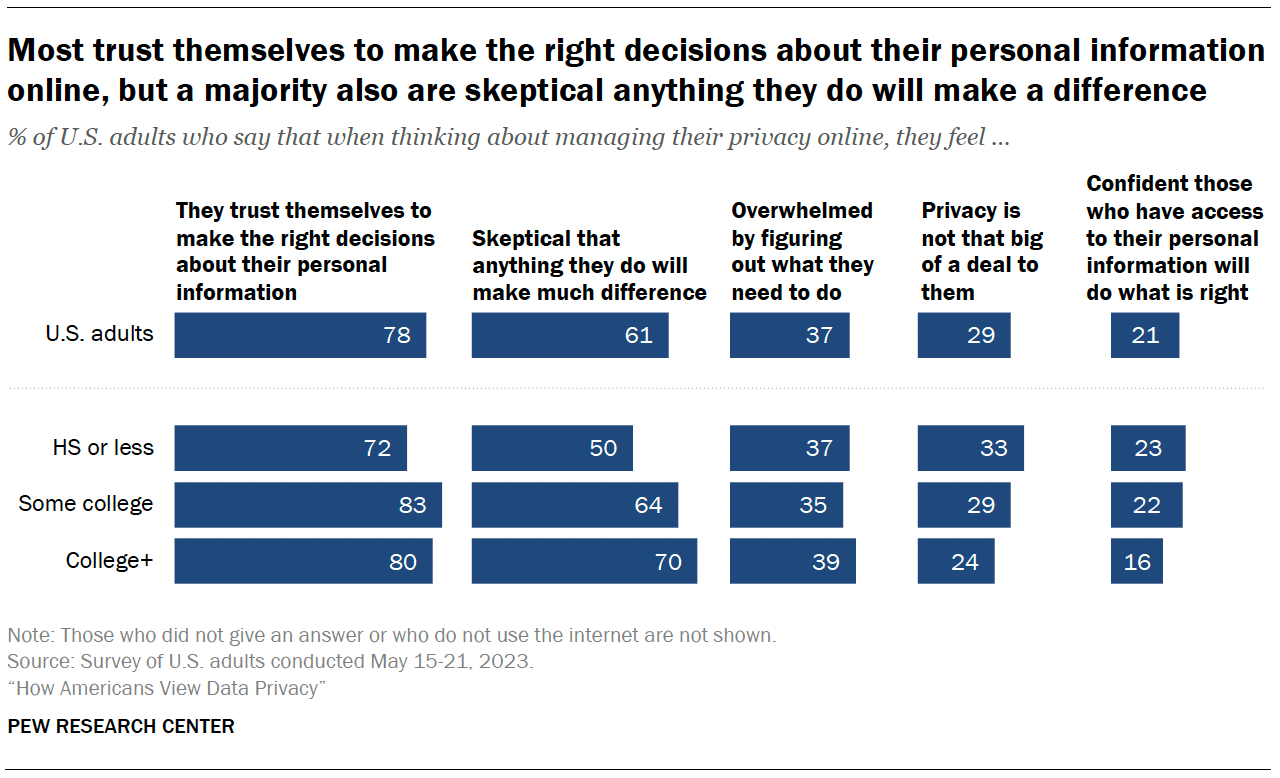
The American privacy landscape is a complex and often contradictory tapestry woven from a multitude of state and federal laws. This fragmented approach to privacy protection has resulted in a patchwork of regulations, leading to significant inconsistencies in how personal data is handled across different parts of the country. Understanding these variations is crucial for businesses operating nationally and individuals navigating the complexities of data protection.
Fragmentation of Privacy Laws
The United States lacks a single, comprehensive federal privacy law. Instead, a variety of state laws, often with differing scopes and enforcement mechanisms, govern personal data collection and use. This disparity creates challenges for businesses attempting to comply with all applicable regulations, leading to increased compliance costs and potential legal risks. The lack of uniformity can also lead to unequal levels of protection for consumers depending on their location.
Levels of Privacy Protection
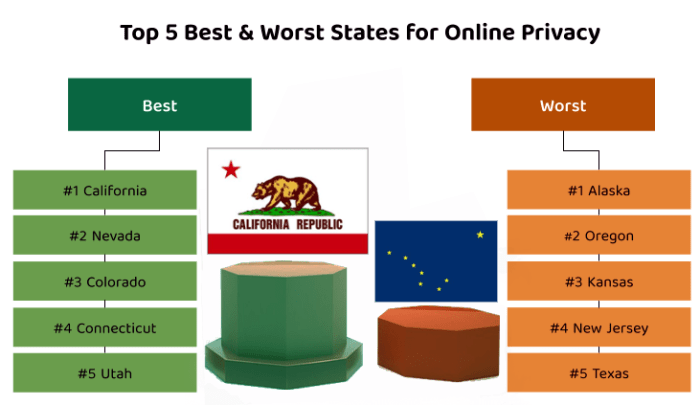
The level of privacy protection varies significantly from state to state. Some states have adopted comprehensive privacy laws that mandate stringent data security measures and provide robust consumer rights, while others have adopted more limited regulations. This variation in standards necessitates a nuanced understanding of the specific laws governing data handling in each state.
Historical Context
The historical context of American privacy law is crucial to understanding the current fragmented state. The absence of a single federal privacy law stems from a combination of factors, including differing priorities among states, the influence of various industries, and the evolution of societal attitudes toward data privacy. Historically, a significant portion of the regulatory framework has been driven by state-level initiatives rather than a national consensus.
Table of State-Level Privacy Laws
| State | Key Privacy Law | Level of Protection |
|---|---|---|
| California | California Consumer Privacy Act (CCPA) | High; comprehensive rights for consumers regarding their personal information. |
| Virginia | Virginia Consumer Data Protection Act (VCDPA) | High; strong emphasis on consumer rights and data security. |
| Colorado | Colorado Privacy Act (CPA) | High; includes broad consumer rights and requirements for data minimization. |
| Connecticut | Connecticut Data Privacy Act | High; covers a wide range of personal data categories and includes significant consumer rights. |
| Utah | Utah Consumer Privacy Act | Medium; covers specific aspects of data collection and use, but not as comprehensive as the highest-level laws. |
| New York | New York Privacy Act (NYPA) | High; a comprehensive law covering various data practices. |
| Other States | Various state laws, including but not limited to specific industry regulations. | Varying levels; some have no specific comprehensive privacy law, while others have targeted regulations. |
Comparing State Privacy Laws
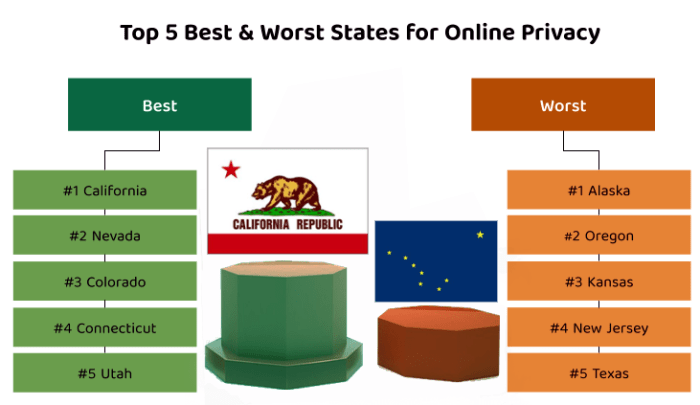
Navigating the intricate web of American privacy laws can feel like deciphering a complex code. Each state has its own set of rules regarding data collection, use, and sharing, creating a patchwork of regulations that businesses must carefully consider. This patchwork makes it essential to understand the nuances of these laws, especially for those operating across multiple states.
California, New York, and Florida, as prominent examples, demonstrate a range of approaches to data privacy.The variations in these laws stem from differing priorities and concerns among states. Some states prioritize consumer protection, while others may focus on the economic impact of privacy regulations on businesses. Understanding these differences is critical for compliance and ensures businesses can navigate the regulatory landscape effectively.
Key Provisions of California’s Consumer Privacy Act (CCPA)
California’s CCPA is a landmark law, establishing robust consumer rights regarding their personal information. The law grants consumers the right to know what personal information a business collects, how it’s used, and with whom it’s shared. Consumers also have the right to request deletion of their personal information, and the right to opt-out of the sale of their personal information.
Key Provisions of New York’s Privacy Act (NYPPA)
New York’s NYPPA expands on the concept of data minimization and purpose limitation. Businesses must limit data collection to only what is necessary for the specified purpose, and any subsequent use must align with the initial purpose. This approach emphasizes the need for transparency and accountability in data handling.
Key Provisions of Florida’s Privacy Law
Florida’s law focuses on the protection of personal information related to children. While it doesn’t have the breadth of regulations seen in California or New York, it specifically targets the collection and use of data from minors, setting specific limitations on the type of data that can be collected and the purposes for which it can be used.
Exemptions and Exceptions to Privacy Protection
Each state’s privacy law contains exemptions and exceptions. These provisions allow for certain types of data collection and use that might otherwise be restricted. For example, some exemptions might apply to public records, or data used for legitimate business purposes. Specific examples of exemptions vary across states.
Data Collection, Use, and Sharing Regulations
California’s CCPA mandates explicit consent for the sale of personal information, whereas New York’s NYPPA focuses on limiting data collection to what is strictly necessary. Florida’s law emphasizes the protection of children’s data. These differences reflect different approaches to balancing business needs with consumer rights.
Comparison of Data Subject Rights, Americas perilous patchwork of privacy laws
| Data Subject Right | California (CCPA) | New York (NYPPA) | Florida |
|---|---|---|---|
| Right to Know | Yes, extensive rights regarding what data is collected, used, and shared | Yes, with a focus on transparency and purpose limitation | Limited to information regarding children’s data |
| Right to Delete | Yes, consumers can request deletion of their data | Yes, with considerations for data retention | Limited scope, likely focused on child-related data |
| Right to Opt-Out | Yes, opt-out of sale of personal information | Focuses on transparency, not specific opt-out rights | Less extensive opt-out provisions |
| Enforcement Mechanisms | Strong enforcement provisions, including penalties | Enforcement mechanisms are evolving | Enforcement mechanisms are developing |
Federal Regulations and State Conflicts
The American privacy landscape is a complex tapestry woven from federal regulations and a multitude of state laws. While the federal government plays a crucial role in establishing baseline protections, the states often add layers of specific regulations to address particular concerns or gaps in federal frameworks. This interplay can lead to both opportunities and challenges.This intricate relationship between federal and state laws often results in overlaps, inconsistencies, and potential conflicts.
America’s privacy laws are a real mess, aren’t they? It’s a confusing patchwork of state and federal regulations, making it tough for businesses to comply. Understanding how tokenization can help address some of these issues is crucial. For example, exploring the five tokenization myths debunked in this helpful resource 5 tokenization myths debunked can offer a clearer picture of how this technology can help navigate the complexities of compliance in this challenging landscape.
Ultimately, a more standardized approach to data protection across the US is needed to simplify things for everyone.
Understanding these dynamics is critical for businesses operating across multiple states, as navigating these varied legal environments can be complex and costly.
Federal Influence on State Laws
Federal regulations often set the stage for state-level privacy laws. For instance, the Health Insurance Portability and Accountability Act (HIPAA) establishes standards for protecting health information. States frequently build upon these federal standards by enacting their own regulations, aiming to further refine protections and address specific local needs. This can result in stricter state requirements in certain areas, but it also introduces the potential for conflicts.
Potential Conflicts Between Federal and State Laws
Disagreements can arise when state laws contradict or are significantly broader than federal regulations. A key example is the ongoing debate surrounding data breach notification laws. While federal guidelines may provide a basic framework, some states have enacted more stringent regulations, leading to conflicting requirements for businesses operating across jurisdictions. Another area of potential conflict is the scope of personal data that is protected.
America’s privacy laws are a real mess, aren’t they? It’s a complicated patchwork of regulations that makes it tough for businesses to navigate. Luckily, companies like Acer are still figuring out how to best approach this issue. Their recent tablet announcements, like acer puts its tablet cards on the table , might offer some interesting insights into how they’re thinking about data security in a fragmented regulatory environment.
This all boils down to how companies can responsibly collect and use user data in this tricky legal landscape.
Some states might include broader categories of personal information than federal law, creating ambiguities for businesses.
Legal Challenges and Litigation
The divergence between federal and state laws often gives rise to legal challenges and litigation. Businesses operating in multiple states must navigate the complex legal landscape, ensuring compliance with all applicable laws. Companies face challenges in implementing policies that meet the diverse and sometimes conflicting standards set by various state and federal regulations. The potential for litigation increases as the gap between federal and state standards widens, especially when businesses are challenged to meet requirements of multiple jurisdictions.
Cases may involve lawsuits claiming violation of state privacy laws, prompting legal battles about preemption, the scope of federal authority, and the validity of state-level additions.
Flow Chart of Potential Interactions
A flowchart illustrating the interplay between federal and state privacy laws would be complex, encompassing various scenarios and possible outcomes. A simplified representation might begin with a federal privacy law, showing potential paths for states to either adopt, modify, or create their own laws. These paths would diverge based on the specific area of privacy regulation and the interplay between federal and state regulations.
- A key consideration is the potential for preemption, where federal law overrides conflicting state laws. For example, a federal law could supersede a state law if it’s deemed to be in direct conflict. This determination is typically made by courts, adding to the complexity of the interplay.
- Conversely, a state law could supplement or add to federal requirements, especially when addressing concerns not adequately covered by federal regulations. This is illustrated by the numerous state laws in the area of data breach notification, which build upon the framework of federal law.
The intricate web of federal and state privacy regulations requires careful consideration and strategic planning for businesses. Navigating this complex environment necessitates a thorough understanding of applicable laws and the potential for conflict. This is particularly crucial for multinational organizations with operations across numerous states, as compliance becomes an increasingly critical concern.
Consumer Impacts and Implications
The American privacy landscape is a complex patchwork of state and federal regulations. This intricate web of laws, while aiming to protect consumers, creates significant challenges for both individuals and businesses. Consumers often find themselves navigating a confusing maze of varying requirements, while businesses struggle to comply with diverse and sometimes conflicting rules across different jurisdictions. This lack of uniformity impacts consumer choices, business operations, and the overall efficiency of the market.This complex system has significant consequences for consumers.
Understanding the intricacies of these laws is crucial to effectively protecting personal data and making informed decisions. The diverse and sometimes contradictory requirements can make it difficult for consumers to comprehend their rights and responsibilities when it comes to their personal information.
Consumer Data Protection Challenges
Consumers face numerous challenges navigating the diverse privacy regulations. The varying definitions of personal data, data collection practices, and consumer rights make it difficult to know exactly what rights they have and what protections are in place in each state. The lack of a unified national standard further complicates matters.
Navigating the Regulatory Landscape
Consumers often struggle to understand which laws apply to them in specific situations. The different rules across states make it challenging to comprehend their rights and responsibilities when sharing personal data. This lack of clarity can discourage consumers from exercising their rights or even knowing they have them.
Business Impacts Across States
Businesses operating across multiple states face considerable difficulties in complying with different privacy regulations. The need to adapt to varying data protection rules across jurisdictions adds to the complexity and cost of doing business. Developing and maintaining systems that comply with all applicable laws can be resource-intensive, particularly for smaller businesses. Maintaining compliance across different states can also be challenging.
Examples of Consumer Impacts
-
Online Shopping and Data Collection: A consumer shopping online might be subject to different data collection and usage practices depending on the state where they reside. Some states have stricter rules regarding the types of data that can be collected, how it can be used, and the required disclosures to consumers. For example, a customer in California has more robust rights to request access, deletion, and correction of their data compared to a consumer in a state with less stringent laws.
-
Health Information and Privacy: The varying privacy regulations concerning health information can significantly impact consumers’ choices. In states with stricter rules, consumers may have more control over how their health data is collected, shared, and used, including the right to access and correct their records. The differing standards across states could affect healthcare access and the ability of healthcare providers to operate in multiple states.
-
Financial Transactions and Data Security: Consumers may encounter different levels of data security protection depending on their location. States with more stringent regulations might require businesses to implement more robust security measures to protect sensitive financial data. Consumers in these states might experience different levels of protection against identity theft and fraud compared to those in states with less comprehensive regulations.
Impact on Businesses Operating Across States
The patchwork of laws significantly impacts businesses operating in multiple states. These businesses face the challenge of developing and maintaining a system that meets the various requirements of each jurisdiction. The cost of compliance and the potential for legal disputes add to the operational difficulties.
Business Strategies for Compliance
Navigating the intricate web of state and federal privacy regulations is a significant challenge for businesses today. The patchwork of laws across the United States demands a nuanced approach, requiring companies to adapt their practices to comply with varying standards. This necessitates a proactive and strategic approach to data privacy, encompassing everything from data collection practices to consumer rights.The complexities extend beyond simply adhering to the letter of the law.
Businesses must also prioritize maintaining customer trust and upholding ethical data handling practices. This intricate balance between compliance and innovation is crucial for sustainable growth and long-term success.
Challenges in Complying with Diverse Regulations
Businesses face a multitude of challenges when trying to comply with the diverse privacy regulations across the United States. The varying standards across states necessitate significant resources and specialized knowledge to ensure comprehensive compliance. This can involve extensive legal review, the creation of updated policies and procedures, and the implementation of new technologies to ensure data security and integrity.
Furthermore, the ever-evolving nature of these laws demands continuous monitoring and adaptation to maintain compliance. Maintaining compliance with new laws and amendments is crucial to avoid penalties and maintain customer trust.
Adapting to the Evolving Legal Landscape
To effectively adapt to the evolving privacy landscape, businesses must adopt a proactive approach to legal research and compliance. This includes establishing a dedicated team or department responsible for monitoring and updating privacy policies. Companies should also implement robust systems for data governance, ensuring that data collection, use, and retention are transparent and in line with legal requirements.
America’s privacy laws are a real mess, aren’t they? It’s like a patchwork quilt, with different states having wildly varying rules. This makes it incredibly difficult for companies to comply, and honestly, it’s a headache for everyone. Twitter’s recent tweaks to their search engine to corral tweets here highlights the growing complexity of navigating this digital landscape.
This just adds another layer to the already precarious situation, and it makes you wonder how much more chaos is lurking in the digital privacy trenches.
Regular audits and reviews are essential to identify potential vulnerabilities and address any compliance gaps proactively. This approach not only mitigates risks but also positions the company for future legal changes.
Balancing Compliance with Innovation and Customer Service
Balancing compliance with innovation and customer service is paramount. Companies must implement privacy-enhancing technologies (PETs) without sacrificing the quality or user experience of their services. For instance, implementing anonymization or pseudonymization techniques can safeguard data while allowing for valuable insights and continued innovation. Furthermore, fostering transparency with customers about data practices can build trust and loyalty. Clear and accessible privacy policies are essential in this regard.
A Step-by-Step Procedure for Assessing and Improving Data Privacy Practices
A structured approach is essential for businesses to assess and improve their data privacy practices across various states. A robust procedure should include the following steps:
- Inventory Data Assets: Thoroughly catalog all data collected, used, and stored, identifying the types of data, sources, and recipients. This step forms the foundation for understanding the scope of data handling practices and potential areas needing improvement.
- Assess Legal Requirements: Conduct a comprehensive review of relevant state and federal privacy laws, including the California Consumer Privacy Act (CCPA), the Virginia Consumer Data Protection Act (VCDPA), and other applicable regulations. This includes analyzing data security requirements and specific obligations in each relevant state.
- Develop a Privacy Policy and Procedures: Create a clear and concise privacy policy that articulates data handling practices, including collection, use, disclosure, and retention. Implement corresponding procedures to ensure consistent application of the policy.
- Implement Data Security Measures: Implement robust security measures to protect data from unauthorized access, use, or disclosure. This includes technical controls, administrative safeguards, and physical security protocols.
- Establish Data Governance and Oversight: Establish clear roles and responsibilities for data governance, ensuring accountability and transparency. This includes designating a data privacy officer or a team to oversee data practices and compliance efforts.
- Train Employees: Provide comprehensive training to all employees involved in data handling to ensure understanding and compliance with data privacy policies and procedures.
- Regularly Review and Update: Schedule regular reviews and updates to policies, procedures, and technologies to maintain compliance with evolving regulations. Regular audits and assessments are crucial to identify any gaps or areas needing improvement.
The Future of Privacy in the US: Americas Perilous Patchwork Of Privacy Laws
The current patchwork of US privacy laws, a complex tapestry woven from state-level initiatives and fragmented federal regulations, presents both opportunities and challenges for the future. The inherent inconsistencies create hurdles for businesses seeking to comply and pose significant implications for consumers. A more unified approach is crucial for fostering economic growth and consumer trust in the digital age.The current state of affairs, marked by a lack of federal standardization, necessitates a proactive approach to future legislation.
The varied interpretations of privacy principles across different states have led to confusion and potential legal conflicts, impacting businesses operating across multiple jurisdictions. Predicting the exact shape of future legislation is difficult, but the need for a more coherent framework is undeniable.
Potential Federal Legislative Changes
A federal privacy law in the US would provide a consistent set of rules for businesses to follow nationwide. This would reduce the compliance burden for companies operating in multiple states and potentially stimulate economic activity by fostering greater certainty and predictability in the market. The potential for a federal law to align with international standards is also a factor to consider, as it could facilitate global data flows and promote American competitiveness in the digital economy.
Influence of the Current Landscape on Future Laws
The current landscape of diverse state laws will likely influence the design of any future federal privacy legislation. States like California with their strong consumer-centric laws are likely to serve as models for certain provisions, while the experiences with existing state laws can highlight both successes and failures. This learning process can inform the design of a more comprehensive and effective federal framework.
Solutions for a Unified Approach
Several solutions could pave the way for a more unified approach to data privacy. One is to establish a federal privacy agency with the authority to interpret and enforce a federal privacy law. This could ensure consistency in application and provide a centralized point of contact for businesses and consumers. Another solution involves a model where the federal government provides a baseline of privacy protections and allows states to augment these protections, rather than replacing them entirely.
This approach could balance federal oversight with state-level flexibility. The establishment of clear and comprehensive guidelines for data breach notification and redress could also play a key role.
Timeline of US Privacy Laws Evolution
| Year | Event | Description |
|---|---|---|
| 1974 | Privacy Act of 1974 | Established federal standards for how government agencies collect, use, and disclose personal information. |
| 2000 | Children’s Online Privacy Protection Act (COPPA) | Created specific rules for the collection and use of children’s personal data online. |
| 2010s | State-level privacy laws emerge | States like California started enacting stronger privacy laws, setting the stage for a more decentralized approach. |
| 2020 | California Consumer Privacy Act (CCPA) | A landmark example of a state-level privacy law that grants consumers significant rights over their data. |
| Present | Ongoing debates and developments | The discussion around a federal privacy law continues with various proposals and legislative actions. |
International Comparisons
Navigating the global landscape of data privacy requires understanding how different countries approach the issue. The US patchwork of state laws stands in stark contrast to the more unified and comprehensive frameworks adopted by other developed nations. These international differences have significant implications for businesses operating across borders and for consumers seeking protection of their personal information.The US, with its decentralized approach, often faces challenges in harmonizing privacy standards.
This contrasts sharply with the EU’s GDPR, a comprehensive and far-reaching regulation that sets a high bar for data protection. Comparing the US system with those of other developed countries like Canada and the UK reveals critical insights into the varying levels of protection and the different philosophies underpinning these laws. Understanding these variations is vital for businesses seeking to comply with international standards and consumers who want assurance about how their data is handled globally.
Comparing US Privacy Laws with International Standards
The US privacy landscape differs significantly from those of other developed countries, primarily due to its decentralized approach to regulation. While federal laws like the CCPA and HIPAA exist, they often lack the comprehensive scope of regulations in other regions. This decentralized system allows for considerable variability in the level of protection afforded to personal data, with each state crafting its own rules.
Key Differences in Data Protection Approaches
The table below highlights key differences in data protection approaches between the US and other developed nations.
| Country | Key Privacy Law | Level of Protection |
|---|---|---|
| United States | Various state and federal laws (e.g., CCPA, HIPAA) | Variable; often considered less comprehensive than EU or Canadian standards |
| European Union | General Data Protection Regulation (GDPR) | High; emphasizes individual rights and data minimization |
| Canada | Personal Information Protection and Electronic Documents Act (PIPEDA) | Comprehensive; sets standards for collecting, using, and disclosing personal information |
| United Kingdom | Data Protection Act 2018 | High; aligns with EU GDPR principles post-Brexit |
Implications for the US Market
The divergent approaches to privacy have tangible implications for US businesses. A lack of harmonization across states can lead to compliance complexities for multinational corporations. This complexity, coupled with the varying levels of protection, can make it challenging to establish consistent data protection practices across the US market. Businesses operating globally must navigate a multitude of legal frameworks, potentially increasing costs and administrative burdens.
Further, consumers may have varying degrees of protection depending on where their data is processed. This difference in protection levels could lead to confusion and potentially harm consumer trust in US companies, impacting their competitiveness on the international stage.
Final Wrap-Up
In conclusion, the American approach to data privacy remains a significant challenge. The current patchwork of state laws creates difficulties for both individuals and businesses operating across multiple jurisdictions. The interplay between state and federal regulations, along with the diverse consumer experiences, highlights the urgent need for a more unified and comprehensive national privacy framework. This article has explored the various facets of this complex issue, offering insights into the current landscape and potential pathways for future improvements.